If you’re buying a home in Arlington Heights, there’s a good chance you’ve had this exact experience:
You find a house you really like.
The layout works.
The neighborhood feels right.
Maybe it’s close to downtown, the Metra, or one of your favorite parts of town.
And then you see the property taxes.
That’s usually the moment where buyers pause and say, “Wait… what?”
Fair. Arlington Heights property taxes can feel confusing, especially if you’re moving from an area where the system is simpler or the tax bills are lower. But they are not random, and once you understand the basics, they become a lot easier to evaluate.
First, there is not one flat Arlington Heights tax rate
This is one of the biggest misconceptions buyers have.
There is not one single Arlington Heights property tax rate that applies to every home. In Cook County, the final bill depends on the property’s assessed value, the state equalization factor, any exemptions on the property, and the local tax rate attached to that parcel. The Cook County Assessor specifically notes that your local tax rate can vary by property.
So when two homes in Arlington Heights have very different tax bills, that does not automatically mean one is a bad deal. It may simply mean the properties have different tax rates, different exemption histories, or different assessed values.
How Cook County property taxes are calculated
Here’s the plain-English version.
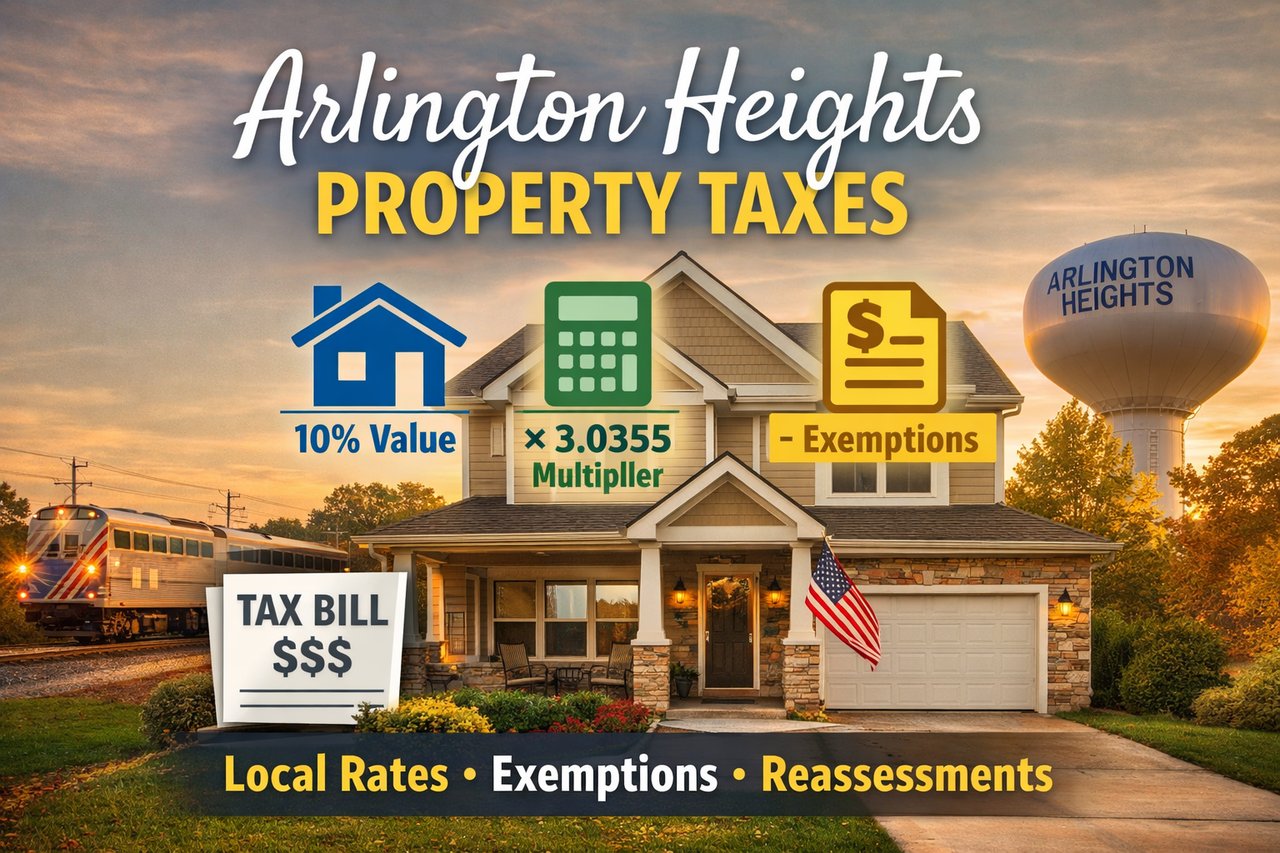
For residential properties in Cook County, the assessed value is generally set at 10% of fair market value. Then the State of Illinois applies an equalization factor, also called the multiplier, to create the property’s Equalized Assessed Value, or EAV. After that, exemptions are subtracted, and the local tax rate is applied to determine the tax bill.
For tax year 2024, the Illinois Department of Revenue announced Cook County’s final equalization factor was 3.0355.
So the formula, in simple terms, looks like this:
Fair market value × 10% = assessed value
Assessed value × equalization factor = EAV
EAV − exemptions = adjusted EAV
Adjusted EAV × local tax rate = tax bill
No, it is not exactly light bedtime reading. But once you know the steps, the numbers stop feeling so mysterious.
Why the tax bill in a listing is only part of the story
This is where buyers need to be careful.
The tax bill shown in a listing is helpful, but it is not always the amount you will end up paying after you buy the home. That’s because the current owner may have exemptions you do not qualify for, or the property may not yet reflect the exemption you will qualify for as an owner-occupant. On top of that, reassessments and appeals can change the numbers over time.
Cook County follows a triennial reassessment cycle, meaning a property is reassessed once every three years depending on its township. The Cook County Assessor states that the north suburbs were reassessed in 2025.
That matters because a buyer should not only ask, “What were the taxes last year?” A better question is, “Were these taxes affected by a recent reassessment, and what exemptions are currently on this property?” That gives you a much clearer picture.
The Homeowner Exemption is a big deal
If the home will be your primary residence, this is one of the most important things to understand.
In Cook County, the Homeowner Exemption reduces the property’s Equalized Assessed Value by $10,000. That does not mean your tax bill drops by $10,000. It means the taxable EAV is reduced by $10,000, and your actual savings depend on the local tax rate for that property. The Assessor’s Office says the average Cook County homeowner saves about $950 per year from this exemption.
There are also timing rules. First-time applicants must have occupied the property as their principal residence on January 1 of the tax year in question, and exemptions are reflected on the second installment tax bill. Once the Homeowner Exemption is in place, it generally renews automatically as long as ownership and residency stay the same.
That’s why buyers should never assume the exemption situation will just sort itself out. It is worth verifying.
Cook County taxes are billed in arrears
This part confuses a lot of people, especially first-time buyers.
Cook County property taxes are billed and due the following year. Property taxes are also billed in two installments. The first installment is due near the beginning of March and is 55% of the previous year’s total tax amount. The second installment reflects updated assessments, tax rates, levies, and exemptions.
As of now, the Cook County Treasurer lists the Tax Year 2025 first installment due date as April 1, 2026.
This is one reason buyers can get confused when they compare one bill to another. The first bill is basically a carryover calculation. The second bill is where the more current numbers show up.
What buyers should really look at
When you are comparing homes in Arlington Heights, don’t just look at the purchase price. Look at the whole monthly picture.
Pay attention to:
-
the current annual property tax bill
-
whether the current owner has exemptions on the property
-
whether you are likely to qualify for the Homeowner Exemption
-
whether the property has recently been reassessed
-
whether your lender is using a realistic tax estimate for your projected payment
Two homes with similar list prices can feel very different once taxes are included in the monthly payment. That is especially true in Arlington Heights.
My honest advice as a local Realtor
Don’t panic when you see a high tax bill.
But don’t ignore it, either.
Property taxes are one of the most important budget numbers in a home purchase, and this is not something to figure out after you’ve already fallen in love with a house. I always think buyers are best served when they look at taxes early, understand what exemptions are in play, and make sure the monthly payment truly feels comfortable. That leads to better decisions and a lot less stress later.
Arlington Heights is a wonderful place to live. I live here myself, and I understand exactly why so many people want to be here. But part of buying wisely is understanding the full cost of ownership, and property taxes are a big part of that picture.
If you’re thinking about buying in Arlington Heights and want help looking at taxes property by property, reach out. I’m always happy to help you make sense of the numbers before you make a move. And if you ever need it, I can also recommend a great tax appeal attorney.
FAQs
Are property taxes the same on every home in Arlington Heights?
No. In Cook County, tax bills vary based on assessed value, the equalization factor, exemptions, and the local tax rate attached to that parcel. That is why two homes in the same town can have noticeably different tax bills.
What does the Cook County Homeowner Exemption do?
It reduces a qualifying owner-occupied home’s Equalized Assessed Value by $10,000. The actual dollar savings depend on the local tax rate, and the Assessor says the average savings is about $950 per year.
When does the Homeowner Exemption show up on the tax bill?
Cook County says exemptions appear on the second installment bill. First-time applicants must have occupied the property as of January 1 of the tax year in question to qualify.
Why is the first property tax bill different from the second one?
Because the first installment is set by law at 55% of the previous year’s total tax amount. The second installment is the one that reflects updated assessments, levies, tax rates, and exemptions.