Updated: August 20, 2026
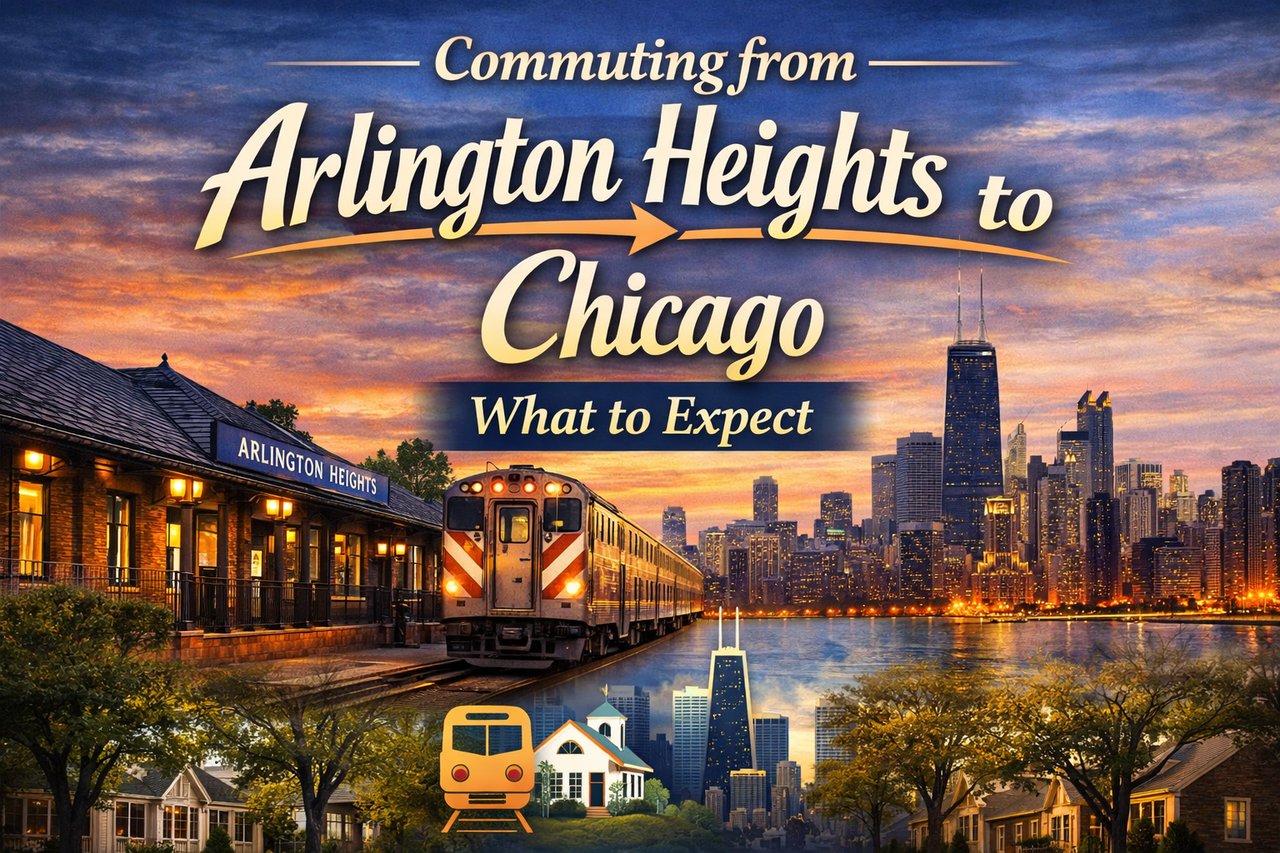
The Metra Union Pacific Northwest Line runs 24 weekday inbound trains from downtown Arlington Heights to Ogilvie Transportation Center, taking 36 to 54 minutes depending on the train. Eight are expresses at 40 minutes or less. A monthly pass plus a resident parking permit runs about $150.
Key Takeaways
- The ride is 36 to 54 minutes. Of 24 weekday inbound trains, 8 are expresses at 40 minutes or less and 16 are all-stop locals at 50 minutes or more. The median is 51 minutes (Metra UP-NW timetable).
- The trip home is faster. Outbound weekday trains run 31 to 47 minutes, median 46.
- Weekend service is thinner: 14 inbound trains on Saturday, 8 on Sunday.
- Commuter parking is $2.00 a day or $40 a month for residents, $50 for non-residents, and free from noon to 2 a.m. and all weekend in daily-fee areas (Village of Arlington Heights).
- Budget about $150 a month for a monthly pass plus a resident permit, roughly $1,800 a year.
- A monthly pass pays off at 10 round trips. Below that, single tickets cost less, which matters on a two-day hybrid schedule.
- The UP-NW ends at Ogilvie, not Union Station. If your office is near Union Station, check the walk before you commit.
How long is the Metra ride from Arlington Heights to Chicago?
Between 36 and 54 minutes, depending on the train. The median weekday inbound trip is 51 minutes.
That spread is not random, and understanding it is the difference between a 36-minute commute and a 54-minute one.
Weekday inbound | Weekday outbound | Saturday inbound | Sunday inbound | |
|---|---|---|---|---|
Trains serving Arlington Heights | 24 | 24 | 14 | 8 |
Trip time range | 36 to 54 min | 31 to 47 min | 37 to 51 min | 37 to 51 min |
Median trip | 51 min | 46 min | 51 min | 51 min |
Source: Metra UP-NW timetable, generated August 20, 2026, matching every Arlington Heights departure to its Ogilvie arrival.
Which trains are the fast ones?
Eight of the 24 weekday inbound trains reach Ogilvie in 40 minutes or less. These are the expresses, and they run during the morning rush. Sixteen are all-stop locals at 50 to 54 minutes, and those are what run midday and evening.
The practical consequence: if your schedule lets you catch a morning express, your commute is 40 minutes. If you routinely leave at 10 a.m., it is 51. Same station, same line, 11 minutes of difference every trip, which is about 90 hours a year.
Before you decide this commute works, find the specific train that matches your start time and check what that one does. Do not budget from the range.
How long is the trip home?
Faster. Outbound weekday trains from Ogilvie to Arlington Heights run 31 to 47 minutes, with a median of 46. The fastest evening trains beat the fastest morning trains by several minutes.
Is there weekend service?
Yes, but noticeably less of it: 14 inbound trains on Saturday and 8 on Sunday, versus 24 on a weekday. Trip times are similar at 37 to 51 minutes.
If part of the appeal is heading into the city on weekends, look at the actual Sunday schedule. Eight trains is a real constraint on a spontaneous afternoon.
How much does it cost to commute from Arlington Heights to Chicago?
About $150 a month, or roughly $1,800 a year, for a Metra monthly pass plus a resident commuter parking permit.
Arlington Heights is in Metra fare Zone 3. Here is the whole picture:
Cost | Amount |
|---|---|
One-way ticket (Zone 1–3) | $5.50 |
Day pass | $11.00 |
Monthly pass | $110.00 |
Commuter parking, daily | $2.00 |
Commuter parking, monthly permit (resident) | $40.00 |
Commuter parking, monthly permit (non-resident) | $50.00 |
Sources: Metra fare table and Village of Arlington Heights. The Metra table carries no effective date and Metra proposed a fare increase in October 2025, so confirm current pricing before you budget.
Does a monthly pass make sense on a hybrid schedule?
Only above about three days a week. Here is the arithmetic:
- A round trip on single tickets costs $11.00, the same as a day pass.
- A monthly pass costs $110.00.
- The pass breaks even at 10 round trips a month.
Two days a week works out to roughly 8.7 round trips a month, or about $95 in tickets. Single tickets win. Three days a week is about 13 round trips, or $143 in tickets. The pass wins, and by a widening margin after that.
Parking works the same way. At $2.00 a day, two days a week costs about $17 a month against a $40 permit. The permit pays off around 20 days.
If you are commuting two days a week, you are probably overpaying if you bought the pass out of habit. Run your own count before you renew.
Where do I park at the Arlington Heights Metra station?
The village runs commuter lots near both the downtown station and the Arlington Park station. Lot A sits west of the Arlington Heights station on Northwest Highway. Lot T is at the Arlington Park station, on the access road west of the platform (Village of Arlington Heights).
The rules that catch people out:
- Daily parking is $2.00, paid through the Passport Parking app or a cash fare box.
- Monthly permits are $40 for residents and $50 for non-residents, sold quarterly through the Finance Department. Availability is not guaranteed from one quarter to the next.
- Parking is free from noon to 2 a.m. daily and all day on weekends in the daily-fee areas.
- Overnight parking between 2 a.m. and 5 a.m. is prohibited without a valid permit. This is the one that surprises people who occasionally leave a car after an evening in the city.
Call the village before you count on a permit. Rates and availability change, and a permit you assumed you would get is a bad thing to discover in week one.
What if my office is near Union Station instead of Ogilvie?
This is the question worth asking before you buy a house here, and almost no commuting guide raises it.
The UP-NW line ends at Ogilvie Transportation Center, not Union Station. They are about two blocks apart, which is fine for most people and not fine for everyone. If your office is south or west of Union Station, that gap plus the walk on the far side can add 15 minutes to every trip.
The obvious alternative is the Milwaukee District West Line, which does run into Union Station. It does not serve Arlington Heights. The nearest MDW station is Schaumburg, roughly 9 miles away.
Having checked the MDW timetable, that alternative is usually not worth it:
UP-NW from Arlington Heights | MDW from Schaumburg | |
|---|---|---|
Terminal | Ogilvie | Union Station |
Weekday inbound trains | 24 | 18 |
Trip time | 36 to 54 min | 44 to 64 min |
Median trip | 51 min | 60 min |
Getting to the station | Walk or short drive | About 9 miles by car |
Source: Metra UP-NW and MDW timetables, generated August 20, 2026.
The MDW train is 9 minutes slower at the median, runs 6 fewer weekday trains, and requires a 9-mile drive to reach. Walking two blocks from Ogilvie is almost always the better trade.
Worth knowing anyway, because if the Union Station walk is a genuine problem for you, this tells you the workaround exists and what it costs. For most people, the answer is to ride from Arlington Heights and walk the two blocks.
There is also a third option people forget: the CTA Blue Line from Rosemont, which reaches parts of the Loop the Metra terminals do not. I wrote about CTA Blue Line access from Rosemont separately.
Is it better to drive or take the train from Arlington Heights?
For a Loop office on a weekday, the train, in most cases. The reason is not speed, it is variance.
A drive downtown from Arlington Heights runs roughly 45 to 75 minutes depending on traffic, weather, construction, and whether anything is happening downtown. The train runs 36 to 54 minutes and does the same thing every day. On a bad morning the car is far worse; on a good morning it is only slightly better.
Main driving routes are I-90 (the Jane Addams Memorial Tollway), Route 53, and I-290, depending on where you are headed.
Driving makes more sense when:
- Your workplace is outside the Loop, where the train drops you nowhere near it.
- You work hours that fall outside the schedule, especially late evenings when locals are all that run.
- Your destination has parking included, which removes the largest hidden cost.
- You need the car during the workday.
Also price downtown parking honestly. Add it to the fuel and tolls, compare it against $150 a month, and the train usually wins on cost as well as predictability.
Do homes near the Arlington Heights Metra station cost more?
Generally yes, and it is measurable. Scarsdale, the subdivision immediately south of downtown, sold at a median $329 per square foot over the past year, against $307 per square foot village-wide for detached homes (ConnectMLS, 556 detached sales, August 2025 through August 2026).
Price per square foot is the fairer comparison here than sale price, since it strips out the fact that homes near downtown tend to be larger and older.
Some of that difference is walking distance to the platform. Some of it is the restaurants and the library being equally close, and some is the age and style of the housing stock, which near downtown skews to earlier construction on bigger lots. You cannot cleanly separate them, and anyone who tells you the premium is purely about the train is guessing.
What it means practically: if avoiding the parking permit is worth money to you, some of that saving is already priced into the house. Decide whether walking to the platform is worth paying for, or whether a five-minute drive and a $40 permit is the better deal for your budget.
For more on how the parts of the village differ, see which Arlington Heights neighborhood fits you. If the tax side is what you are weighing, I break down how Arlington Heights property taxes are calculated separately.
How does hybrid work change the math?
It changes it more than most people account for.
At five days a week, the commute is the dominant fact of your weekday and it is worth optimizing everything around: catching an express, living near the platform, buying the pass.
At two days a week, most of that inverts. Single tickets cost less than the pass. Daily parking costs less than the permit. An extra ten minutes on a local matters far less. And the house three miles from the station, which is cheaper per square foot, starts looking better than the one you would pay a premium for.
The honest version: run the count. How many days, at what hour, to which building, and how do you get from the terminal to your desk. Then price that specific pattern rather than the generic one.
Test the commute before you choose a house
This is the advice I give everyone, and the people who take it never regret it.
Ride the actual train, on a weekday, at your actual hour. Not a Saturday, not midday, not an estimate from a mapping app. Get to the station the way you would really get there, park where you would really park, take the train you would really take, and walk from Ogilvie to your building.
Do it once. You will know more in one morning than any article can tell you, including this one.
Then do the same drive at the same hour on a different day, so you know what the alternative actually feels like.
For a broader look at what living here involves beyond the commute, see the complete Arlington Heights local guide. If walking to the platform is the version you want, I wrote separately about living near downtown Arlington Heights.
Common questions about the Arlington Heights commute
How long does it take to commute from Arlington Heights to Chicago by train?
Between 36 and 54 minutes to Ogilvie Transportation Center, with a median of 51. Of the 24 weekday inbound trains, 8 are expresses at 40 minutes or less and 16 are all-stop locals at 50 minutes or more (Metra UP-NW timetable, August 2026).
How much does Metra cost from Arlington Heights to Chicago?
Arlington Heights is Zone 3. A one-way ticket is $5.50, a day pass $11.00, and a monthly pass $110.00. Add $40 a month for a resident parking permit and budget about $150 monthly. Metra proposed an increase in October 2025, so confirm current fares.
Where do I park at the Arlington Heights Metra station?
Lot A sits west of the downtown station on Northwest Highway, and Lot T serves the Arlington Park station. Parking is $2.00 daily or $40 monthly for residents, $50 for non-residents, and free from noon to 2 a.m. and on weekends in daily-fee areas.
Does the Arlington Heights train go to Union Station?
No. The Union Pacific Northwest Line ends at Ogilvie Transportation Center, about two blocks from Union Station. The Milwaukee District West Line serves Union Station but does not stop in Arlington Heights; its nearest station is Schaumburg, roughly 9 miles away.
Is it better to drive or take the train from Arlington Heights to Chicago?
For a weekday Loop commute, usually the train, because of predictability rather than speed. Driving runs 45 to 75 minutes depending on traffic; the train runs 36 to 54 every day. Driving makes more sense for workplaces outside the Loop or hours outside the schedule.
Is a Metra monthly pass worth it if I only go in two days a week?
Usually not. A round trip on single tickets is $11.00 and a monthly pass is $110, so the pass breaks even at 10 round trips a month. Two days a week is about 8.7 round trips. Three days a week is about 13, where the pass wins.
Equal Housing Opportunity. Mari and the Dragonfly Home Team conduct business in accordance with the federal Fair Housing Act and the Illinois Human Rights Act. This article is general information about local transportation and housing and is not legal, tax, or financial advice. Schedules, fares, and parking rules change; confirm current details with Metra and the Village of Arlington Heights. Please talk with your own attorney, tax professional, or lender about your situation.