Updated: August 13, 2026
What homes actually sold for, what taxes really run, and how the Metra commute works, from someone who works this market every week.
Arlington Heights is a village of about 76,000 in Cook County, 25 miles northwest of downtown Chicago. Between August 2025 and August 2026, detached homes sold for a median of $590,000 and condos and townhomes for $265,000. Downtown has a Metra station on the Union Pacific Northwest Line, about 35 to 45 minutes from Ogilvie.
Key Takeaways
- Arlington Heights had an estimated population of 76,216 as of July 1, 2025, and covers 16.61 square miles in Cook County (U.S. Census Bureau).
- Over the 12 months ending August 13, 2026, 556 detached homes sold at a median of $590,000 and 395 condos and townhomes sold at a median of $265,000 (ConnectMLS).
- Homes are moving fast. Half of detached homes sold in 8 days or less, and 66% sold at or above the asking price.
- A typical annual property tax bill ran about $8,900 on a $450,000 to $600,000 house and about $11,000 on a $600,000 to $800,000 house, based on the most recent bills attached to those sales.
- The downtown Metra station sits in fare zone 3, 22.9 miles from Ogilvie, with 1,944 parking spaces across 12 lots (Metra).
- Several school districts serve different parts of the village, so attendance boundaries have to be confirmed address by address.
- The 326-acre former Arlington Park racetrack has no confirmed future. The Bears voted in June 2026 to advance a stadium in Hammond, Indiana instead.
Where is Arlington Heights, IL?
Arlington Heights is in Cook County, about 25 miles northwest of downtown Chicago. Here is how it sits relative to places people ask about:
- Downtown Chicago and Ogilvie Transportation Center: about 25 miles by road, 22.9 rail miles
- O'Hare International Airport: about 10 miles
- Schaumburg and Woodfield Mall: about 9 miles
- Northbrook: about 12 miles
The village borders Mount Prospect, Buffalo Grove, Palatine, Rolling Meadows, and Wheeling. Access to Metra, Route 53, I-90, and O'Hare is a big part of why people with very different commutes end up looking here.
A few numbers that fill in the picture, all from the Census Bureau's 2020–2024 estimates: median household income of $116,723, and a homeownership rate of 74.0%.
How much do homes cost in Arlington Heights?
Detached homes sold for a median of $590,000 and condos and townhomes for a median of $265,000 over the 12 months ending August 13, 2026. Those are two separate markets, and blending them into one number is where most town guides go wrong.
Everything in this section comes from 951 closed sales pulled from ConnectMLS, our local MLS. Not estimates. Actual recorded sale prices.
What does a single-family house cost in Arlington Heights?
556 detached homes sold. The median was $590,000, and the middle half ran from $490,000 to $730,000.
Price tracks closely with the style of house, which in this village mostly means the era it was built in:
Style | Homes sold | Median sale price |
|---|---|---|
Split level | 75 | $501,000 |
Ranch (1 story) | 133 | $510,000 |
1.5 story | 18 | $531,500 |
Split level with sub-basement | 50 | $573,750 |
Two story | 268 | $700,000 |
Here is how the 556 sales spread out across price ranges:
Price range | Homes sold |
|---|---|
Under $450,000 | 94 |
$450,000 to $600,000 | 204 |
$600,000 to $800,000 | 168 |
$800,000 to $1 million | 29 |
Over $1 million | 61 |
So there is real inventory under $450,000, about one sale in six. It tends to be smaller ranches and split levels that need work. And there is a genuine upper end: 61 homes cleared $1 million, most of them new construction. Sixteen homes built in 2021 or later sold at a median of $1,622,500, typically around 3,600 square feet. Those are almost always teardown-and-rebuild projects on existing lots.
Across all detached sales, the median worked out to about $305 per square foot.
What does a condo or townhome cost in Arlington Heights?
395 condos and townhomes sold, at a median of $265,000. This is the part of the market that matters most if you are downsizing, and it is much more affordable than the published guides suggest.
Bedrooms | Units sold | Median sale price | Median monthly assessment |
|---|---|---|---|
1 bedroom | 86 | $180,000 | $370 |
2 bedroom | 210 | $258,000 | $435 |
3 bedroom | 76 | $388,000 | $362 |
The middle half of all attached sales fell between $198,500 and $394,000. Only 16 units sold above $600,000, and those are mostly newer buildings within a few blocks of the train.
One thing to watch: the monthly assessment. A $258,000 two-bedroom with a $435 assessment costs about $5,200 a year on top of the mortgage and taxes. Ask what the assessment covers, when it last went up, and whether the association has money set aside for the roof and parking lot. That last question has saved more than one of my clients from an unpleasant surprise.
How fast are homes selling in Arlington Heights?
Fast. Half of detached homes went under contract in 8 days or less. 63% sold within two weeks, and 48% sold within a single week. Two thirds sold at or above the asking price.
Condos and townhomes moved a bit slower, with a median of 13 days and 47% selling at or above asking.
The average is higher than the median, at about 26 days for detached homes, because a handful of listings sit for months and pull the average up. If you are shopping, plan around the median. Practically, that means having your financing lined up before you tour anything, and being ready to see a home the day it hits the market rather than the following weekend.
As of August 13, 2026, there were 165 active listings in the village: 68 detached homes at a median asking price of $649,900, and 97 condos and townhomes at a median asking price of $305,000.
Why is the Census median home value lower than the MLS number?
Because they measure different things. The Census reports a median value of $414,500 for owner-occupied homes, but that figure comes from homeowners estimating what their own home is worth across a five-year survey window, and it counts every home in the village including ones nobody has sold in thirty years. The MLS number reflects what buyers actually paid this year.
Both are real. If you are budgeting for a purchase, use the sale prices.
What are property taxes like in Arlington Heights?
A typical Arlington Heights property tax bill ran about 1.6% of the home's sale price, which works out to roughly $8,900 a year on a house in the $450,000 to $600,000 range. Here are the actual median bills attached to the homes that sold:
Sale price range | Median annual tax bill |
|---|---|
Under $450,000 | $7,585 |
$450,000 to $600,000 | $8,944 |
$600,000 to $800,000 | $10,979 |
$800,000 to $1 million | $14,046 |
Over $1 million | $18,435 |
For condos and townhomes, the median bill was $4,112.
Two honest caveats. Most of these bills are from tax years 2023 and 2024 measured against 2025 and 2026 sale prices, so the current percentage is somewhat higher than 1.6%. And exemptions matter enormously. A bill that reflects a longtime owner's homeowner and senior exemptions will not be the bill you get.
That is the part people miss. Two houses on the same block, sold for nearly the same price, can carry tax bills that differ by thousands of dollars, because the assessment, the exemptions, and the specific taxing districts are all different.
Before you make an offer, pull the actual bill, the assessed value, the exemptions currently applied, and the last three years of history. I walk through exactly how to read all of it in my guide to how Cook County property taxes work.
What are the neighborhoods like in Arlington Heights?
Arlington Heights is 16.61 square miles, and the housing stock changes noticeably from one part of the village to another. Rather than describing how areas "feel," here is what actually sold in each one over the past year.
Downtown Arlington Heights
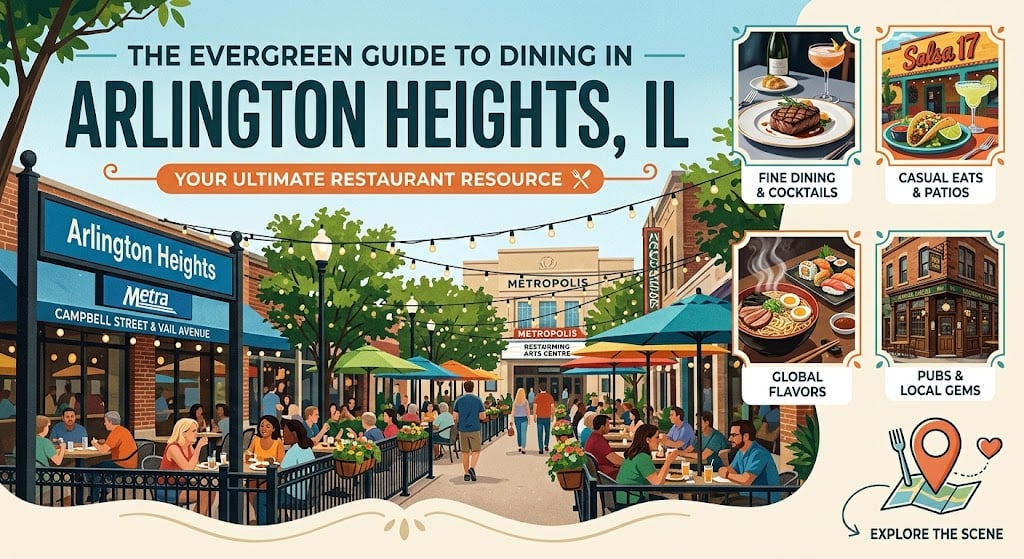
Downtown is built around the Metra station along Northwest Highway, with restaurants and shops concentrated on Vail Avenue, Campbell Street, and the blocks around them. Metropolis Performing Arts Centre and the Arlington Heights Memorial Library are both here.
Places people ask me about: Passero, Salsa 17, Hey Nonny, La Zingara Trattoria, Scratchboard Kitchen, Peggy Kinnane's, and Mago Grill and Cantina. In warmer months, Arlington Alfresco closes streets for outdoor dining.
Housing downtown is a mix of newer condo buildings, older walk-ups, and single-family homes on the surrounding blocks. Homes within a few blocks of the station generally sell at the upper end of both the condo and detached ranges.
Areas with mostly detached homes
Listed alphabetically. Each figure is the median of actual closed sales in that subdivision over the 12 months ending August 13, 2026.
Area | Homes sold | Median sale price | Median days on market | Typical build year |
|---|---|---|---|---|
Berkley Square | 14 | $585,500 | 4 | 1968 |
Ivy Hill | 14 | $628,750 | 6 | 1970 |
Northgate | 18 | $578,750 | 12 | 1972 |
Pioneer Park | 12 | $614,500 | 16 | 1960 |
Scarsdale | 20 | $666,250 | 7 | 1952 |
Surrey Ridge | 10 | $593,000 | 10 | 1969 |
Terramere | 14 | $692,500 | 6 | 1984 |
Scarsdale, south of downtown, has the oldest housing stock of the group, with Tudors, Colonials, Victorians, and American Four-Squares on larger lots. Terramere, on the north end, was built about thirty years later and shows it in floor plans and ceiling heights. Northgate, Berkley Square, and Surrey Ridge are largely brick ranches, split levels, and two-story Colonials from the late 1960s and early 1970s.
Condo and townhome communities
Community | Units sold | Median sale price | Median days on market | Typical build year |
|---|---|---|---|---|
Brandenberry Park | 15 | $175,000 | 24 | 1974 |
Dana Point | 16 | $196,000 | 52 | 1972 |
Greenbrier | 18 | $437,500 | 6 | 1970 |
Lake Arlington Towne | 19 | $369,000 | 16 | 1988 |
Mallard Cove | 22 | $190,000 | 28 | 1971 |
Windsor Woods | 16 | $185,000 | 19 | 1972 |
Greenbrier's higher median reflects a mix of detached homes and attached units selling in the same subdivision. Lake Arlington Towne, built in the late 1980s near Lake Arlington, is the newest of the group.
If you are downsizing and assuming you cannot afford to stay in Arlington Heights, look at that table again. Several of these communities have two-bedroom units trading under $200,000.
How do Arlington Heights schools work?
Several districts serve different parts of Arlington Heights, and the assigned schools can change from one street to the next. There is no single "Arlington Heights school district."
Much of the central village is served by Arlington Heights School District 25 for elementary and middle school. Other portions fall within Community Consolidated School District 21, Prospect Heights School District 23, or Community Consolidated School District 59. High school assignments commonly fall within Township High School District 214, but which high school depends on the address.
Confirm attendance boundaries directly with the district before you write an offer. Listing sites and third-party school directories are frequently out of date, and a boundary that was accurate two years ago may not be accurate now. District offices will confirm an assignment for a specific address, and most publish a boundary lookup tool.
For enrollment, testing, and school-level data straight from the state, use the Illinois Report Card.
How do people get around Arlington Heights?
Which Metra line serves Arlington Heights?
The downtown Arlington Heights station is on the Union Pacific Northwest Line, which runs to Ogilvie Transportation Center in downtown Chicago. A typical trip takes about 35 to 45 minutes depending on the train.
The station is in fare zone 3, 22.9 rail miles from Ogilvie. As of this update, a one-way ticket runs $5.50, a day pass $11.00, and a monthly pass $110.00. Confirm current fares on Metra's site before you budget, since they change.
There are 1,944 parking spaces across 12 lots at the station, 667 of them daily-only. That matters more than it sounds. Permit waitlists at Metra stations in this corridor can run long, and knowing whether you can park on day one is worth a phone call to the village at 847-368-5000 before you commit to a commute.
The station's downtown location means people living nearby can reach the train, restaurants, and the library on foot.
How long is the drive from Arlington Heights to Chicago or O'Hare?
- Downtown Chicago: 45 to 75 minutes, depending heavily on traffic
- O'Hare International Airport: 15 to 20 minutes
- Schaumburg and Woodfield Mall: about 15 minutes
Main routes are I-90, Route 53, Rand Road, Arlington Heights Road, and Northwest Highway.
Is Arlington Heights walkable?
Downtown is the most walkable part of the village. From the blocks immediately around the Metra station, the restaurants, shops, library, and performing arts center are all within a few minutes on foot.
Outside of downtown, the village is mostly car-oriented. Sidewalk coverage varies by subdivision and by era of construction, and some of the 1960s and 1970s areas have gaps. If getting around on foot matters to you, walk the specific block at the specific time of day you would actually be walking it. That tells you more than any score.
What is there to do in Arlington Heights?
The Arlington Heights Park District manages 58 parks across roughly 715 acres of owned and leased land, along with five outdoor pools, one indoor pool, five community centers, a cultural arts center, a senior center, and two golf courses at Arlington Lakes and Nickol Knoll.
Lake Arlington is a 50-acre lake with a 1.8-mile walking and biking path, fishing, and sailing. Dogs are not permitted at Lake Arlington, so if you walk a dog daily, check the park district's current rules and look at other locations before you assume.
Downtown hosts the Arlington Heights Farmers Market, Arlington Alfresco, live music, and performances at Metropolis Performing Arts Centre throughout the year. The Arlington Heights Memorial Library runs classes, workshops, children's programming, and technology resources.
What is happening with the Arlington Park site?
As of August 2026, the future of the 326-acre former Arlington Park racetrack is unresolved. The Chicago Bears bought the property at 3200 W. Euclid Avenue in February 2023, but on June 5, 2026, the team's board voted to advance a stadium project in Hammond, Indiana instead.
Here is the short version of how it got here, from the Village of Arlington Heights:
- November 2022: The Village Board approved a pre-development agreement.
- February 2023: The Bears purchased the 326-acre site.
- December 2024: A memorandum of understanding with the local school districts set the property's assessment at $125 million through 2027, settling a long-running dispute.
- Fall 2025: The Bears paused their traffic analysis after state legislation stalled.
- June 1, 2026: The Illinois legislature adjourned without passing the megaprojects bill the stadium plan depended on.
- June 5, 2026: The Bears board voted to advance the Hammond, Indiana project.
What nobody can tell you right now is what gets built on those 326 acres, or when. Village officials have said their focus is developing the property at its highest and best use, and some of the language coming out of the Bears organization has been read as leaving a door open. Neither of those is a plan.
What this means if you are buying here: do not price a home based on what might happen at Arlington Park, in either direction. The site has been an open question since 2021 and may stay one for a while. Buy the house, the block, and the commute you actually want. If the site is redeveloped in a way that affects your street, that is years out and you will have time to react.
How does Arlington Heights compare with Palatine, Mount Prospect, and Buffalo Grove?
There is no single Northwest Suburb that is right for everyone. The better question is which one fits your commute, your budget, and the kind of house you want to maintain.
Some factual differences to work with:
Arlington Heights and Palatine. Both sit on the Metra Union Pacific Northwest Line and both have a downtown district built around the station. Palatine's entry prices run lower in a number of subdivisions. Arlington Heights has a larger concentration of restaurants and entertainment within walking distance of its station.
Arlington Heights and Mount Prospect. Also on the UP-NW line, and closer to O'Hare from most of the village. Housing stock is comparable in age. Downtown Mount Prospect is smaller than downtown Arlington Heights but has been actively redeveloping.
Arlington Heights and Buffalo Grove. Buffalo Grove's housing stock is generally newer, and it has no station on the UP-NW line, so the commute pattern is different. Buyers usually compare these two on price per square foot, lot size, and how they get to work.
If it helps to see this kind of comparison worked through in detail, I did one comparing two Northwest Suburbs side by side.
What is it actually like to live in Arlington Heights?
Daily life here depends a lot on where in the village you land. Someone in a downtown condo walks to the train, picks up dinner on Vail Avenue, and may drive twice a week. Someone in Terramere or Northgate drives for nearly everything and has a yard and a garage in exchange.
Both of those are Arlington Heights. Neither is more correct.
What I would tell anyone seriously considering a move here: go spend a Saturday. Walk the downtown, drive through two or three of the subdivisions in your price range, stop at a park, and then drive your actual commute at the actual hour you would be driving it. Do that once and you will know more than any guide can tell you, including this one.
And if you are looking at this because something in your life is changing rather than because you woke up wanting to move, that is worth naming. Sorting through prices and taxes and school boundaries is hard enough without also carrying a divorce, a parent's health, or a job that relocated. You do not have to figure all of it out at once.
Thinking about a move to Arlington Heights?
A few guides that pair well with this one:
- How Cook County property taxes work, so the monthly number does not surprise you
- What to inspect before buying a home, including issues that come up often in homes built in the 1950s through 1970s
- IHDA down payment assistance for Illinois buyers, if you may qualify
Common questions about living in Arlington Heights
What do homes cost in Arlington Heights, IL?
Between August 2025 and August 2026, detached homes sold for a median of $590,000 and condos and townhomes for a median of $265,000, based on 951 closed sales in ConnectMLS. The middle half of detached sales ran $490,000 to $730,000.
How fast do homes sell in Arlington Heights?
Very fast. Half of detached homes sold in 8 days or less, and 63% sold within two weeks. Two thirds sold at or above asking price. Condos and townhomes had a median of 13 days. A few slow listings pull the average up to about 26 days.
What are property taxes in Arlington Heights?
Roughly 1.6% of a home's sale price, based on the most recent bills attached to homes that sold. That was about $8,944 a year on homes selling for $450,000 to $600,000, and $10,979 on homes from $600,000 to $800,000. Exemptions change the number significantly.
Is Arlington Heights walkable?
Downtown is. From the blocks around the Metra station, you can reach restaurants, shops, the library, and Metropolis Performing Arts Centre on foot. The rest of the village is largely car-oriented, and sidewalk coverage varies by subdivision.
Is the Bears stadium being built in Arlington Heights?
No. The Bears bought the 326-acre Arlington Park site in February 2023, but on June 5, 2026 the team's board voted to advance a stadium project in Hammond, Indiana. The future of the Arlington Heights property has not been determined.
Can I still afford Arlington Heights if I am downsizing?
Often, yes. 395 condos and townhomes sold over the past year at a median of $265,000, with one-bedroom units at a median of $180,000 and two-bedrooms at $258,000. Monthly assessments ran a median of about $410, which should be factored into any comparison.
Equal Housing Opportunity. Mari Van Meter and the Dragonfly Home Team conduct business in accordance with the federal Fair Housing Act and the Illinois Human Rights Act. This article is general information about a local housing market and is not legal, tax, or financial advice. Market data reflects a specific period and will change. Please consult your attorney, tax professional, or lender about your own situation.