Updated: August 30, 2026
Arlington Heights does not have one flat property tax rate. Each property’s bill depends on its assessed value, Illinois equalization factor, exemptions, and the combined tax rate for the taxing districts serving that parcel. Two nearby Arlington Heights homes can therefore have very different property tax bills.
Key Takeaways
- There is no single Arlington Heights property tax rate that applies to every home.
- Cook County residential property is generally assessed at 10% of estimated fair market value.
- The Illinois state equalization factor is applied to the assessed value to calculate the Equalized Assessed Value, or EAV.
- The Cook County Homeowner Exemption reduces the EAV by $10,000 for qualifying owner-occupied properties. It does not reduce the actual tax bill by $10,000.
- Arlington Heights properties were part of Cook County’s 2025 north suburban reassessment cycle.
- Cook County property taxes are billed in arrears and paid in two installments.
- For Tax Year 2025, the second-installment tax bill is due October 1, 2026.
- The property tax amount shown in an MLS listing is a useful starting point, but it may not represent what a new owner will ultimately pay.
How Do Property Taxes Work in Arlington Heights?
Property taxes in Arlington Heights are calculated through Cook County’s property tax system rather than through one Arlington Heights tax rate.
Your bill is affected by several pieces:
- The Cook County Assessor’s estimated fair market value of the property
- The assessed value
- The Illinois state equalization factor
- Any exemptions applied to the property
- The combined tax rate for the taxing districts connected to that parcel
This is why looking at the sale price alone does not tell you what the property taxes should be.
Two nearby homes can have similar market values and still show different tax bills.
For buyers, the more useful question is not simply, “What are the taxes?”
It is: “Why are the taxes this amount, and what could change after I buy the home?”
How Are Cook County Property Taxes Calculated?
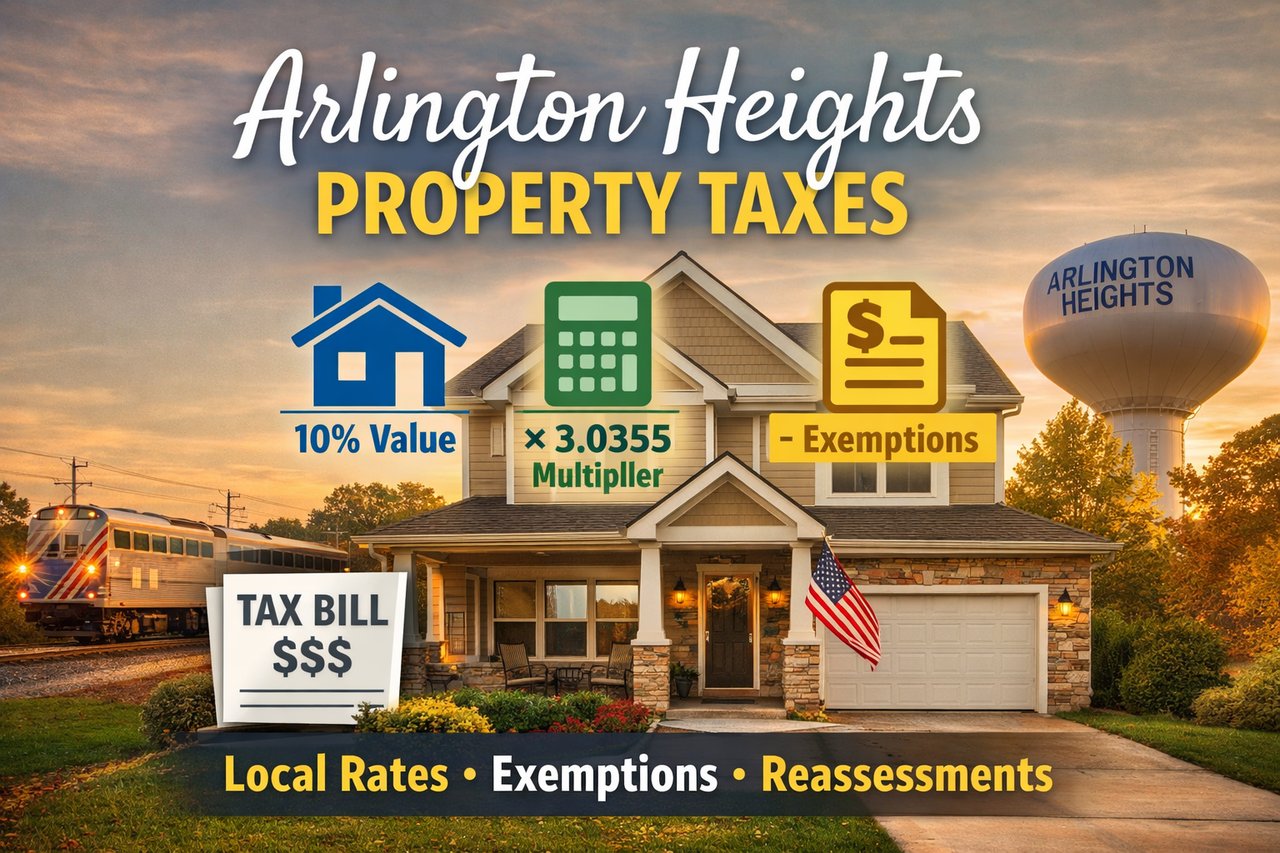
For residential property in Cook County, the assessed value is generally 10% of the Assessor’s estimated fair market value. From there, the state equalization factor, exemptions, and local tax rate are used to determine the bill.
Here is the basic process.
How Is the Assessed Value Calculated?
Cook County generally assesses residential property at 10% of estimated fair market value.
For example, if the Assessor estimates a home’s fair market value at $600,000:
$600,000 × 10% = $60,000 assessed value
The Assessor’s estimated market value is not necessarily the same as the home’s list price or the price you pay for it.
You can review assessment information through the Cook County Assessor’s Office.
What Is the Illinois Equalization Factor?
The assessed value is multiplied by the Illinois state equalization factor, sometimes called the multiplier.
This produces the property’s Equalized Assessed Value, or EAV.
The equalization factor changes by tax year, so use the correct year when reviewing or estimating a bill.
Current property tax statistics and equalization information are available through the Illinois Department of Revenue.
How Do Property Tax Exemptions Affect the Bill?
Qualifying exemptions reduce the property’s EAV before the tax rate is applied.
For example, the Cook County Homeowner Exemption currently reduces EAV by $10,000 for eligible owner-occupied properties.
That does not mean your actual tax bill drops by $10,000. The dollar savings depend on the combined tax rate for that parcel.
How Is the Local Tax Rate Applied?
The adjusted EAV is multiplied by the combined tax rate associated with the parcel.
That combined rate reflects the taxing bodies serving the property. Depending on the address, those can include school districts, park districts, municipalities, libraries, county government, and other local taxing districts.
Step | Calculation |
|---|---|
Fair market value × 10% | Assessed Value |
Assessed Value × State Equalization Factor | Equalized Assessed Value |
EAV − Eligible Exemptions | Adjusted EAV |
Adjusted EAV × Combined Tax Rate | Property Tax |
It sounds complicated because there are several moving pieces, but you do not need to become a property tax expert before buying a home.
You do need to understand enough to recognize when a number deserves a closer look.
For a broader explanation of the system, read my guide to how Cook County property taxes work across the Northwest Suburbs.
Why Can Two Arlington Heights Homes Have Different Property Taxes?
Two Arlington Heights homes with similar sale prices can have different property tax bills because taxes depend on more than current market value.
Differences can come from:
- Different assessed values
- Different exemptions
- Previous assessment appeals
- Property improvements
- Different taxing districts
- Changes made during reassessment
This is one reason I do not recommend looking at the tax bill on one nearby house and assuming another property should have the same taxes.
Always look up the individual parcel.
Should You Trust the Property Tax Amount in an MLS Listing?
Use the property tax amount in an MLS listing as a starting point, not as a guarantee of what you will pay after buying the home.
The listing normally reflects the tax information associated with the current property and owner.
Several things may change after closing.
Do the Seller’s Property Tax Exemptions Transfer to the Buyer?
No. A seller’s exemptions should not be assumed to transfer automatically to a new owner.
The current owner may have a Homeowner Exemption, Senior Exemption, Senior Freeze, or another exemption. Your eligibility will depend on your own circumstances and when you begin occupying the home.
Always review which exemptions are currently applied to a property before relying on the existing tax bill.
Can a Reassessment Change the Property Tax Bill?
Yes. Reassessment can change the assessed value used in the property tax calculation.
Cook County reassesses one-third of the county each year on a three-year cycle.
Arlington Heights spans portions of several north suburban Cook County townships, including Wheeling, Palatine, and Elk Grove. Those north suburban townships were part of Cook County’s 2025 triennial reassessment cycle.
Those reassessment changes affect the 2025 tax-year bills being paid in 2026.
If you are buying an Arlington Heights home in 2026, I would pay particular attention to the current second-installment tax bill rather than relying only on an older annual tax figure.
Does Buying a Home Reset the Property Taxes to the Purchase Price?
No. Buying a home in Cook County does not create a simple automatic property tax calculation based only on the purchase price.
The Cook County Assessor values residential property using property characteristics and market data, including comparable sales. A recent sale may be relevant market information, but the tax bill is still determined through Cook County’s assessment, equalization, exemption, and levy system.
If you are given a future tax estimate based only on the purchase price, ask how that number was calculated. Cook County taxes are not determined by applying one simple percentage to what you paid for the home.
What Does the Cook County Homeowner Exemption Do?
The Cook County Homeowner Exemption reduces the Equalized Assessed Value of an eligible owner-occupied home by $10,000.
It does not reduce the actual property tax bill by $10,000.
Your dollar savings depend on the property’s combined tax rate.
Once an approved Homeowner Exemption is established, it generally renews automatically as long as the owner’s residency remains the same.
For a new buyer, however, do not assume the seller’s exemption simply follows you.
If you are buying a home as your principal residence, confirm:
- When you become eligible
- Whether you need to apply
- Which tax year the exemption will affect
- Whether the exemption appears correctly once it should be in place
You can verify current eligibility and application requirements through the Cook County Assessor’s Homeowner Exemption information.
When Was Arlington Heights Last Reassessed?
Arlington Heights properties in Cook County’s north suburban townships were part of the 2025 triennial reassessment cycle.
Cook County reassesses one-third of the county each year. The 2025 cycle included north and northwest suburban townships.
That matters for homeowners and buyers looking at tax bills in 2026 because assessment changes from 2025 are reflected in the 2025 tax-year bills being paid during 2026.
A bill based on a newly reassessed value may look different from previous years.
I would not compare only the total tax amount. I would also look at:
- The Assessor’s current estimated fair market value
- The current assessed value
- Previous assessed values
- Current exemptions
- Whether an assessment appeal affected the value
That gives you much better context for understanding why the bill changed.
When Are Cook County Property Taxes Due in 2026?
Cook County property taxes are paid in two installments. For Tax Year 2025, payable in 2026, the first installment was due April 1, 2026, and the second installment is due October 1, 2026.
Current bills and payment information are available through the Cook County Treasurer.
Because due dates can change from year to year, always verify the current deadline instead of assuming it will fall on the same date each year.
Why Does Cook County Have Two Property Tax Installments?
Cook County property taxes are billed in arrears and divided into two installments.
“In arrears” means taxes for one tax year are generally paid during the following calendar year.
For example, Tax Year 2025 property taxes are being paid during 2026.
How Is the First Property Tax Installment Calculated?
The first installment is based on the prior year’s total tax bill rather than a completely new tax calculation.
Under the current system, the first installment generally equals 55% of the previous year’s total tax bill.
That means the first installment may not show the full effect of a reassessment, new exemptions, changed tax rates, or updated levies.
Why Can the Second Property Tax Installment Change More?
The second installment reflects the updated tax calculation.
This is where changes in assessment, exemptions, taxing-district levies, and tax rates are more fully reflected.
That is why I pay particularly close attention to the second-installment bill when evaluating a property.
How Do Property Taxes Work When You Buy a Home?
Because Cook County taxes are paid in arrears, property taxes are normally prorated between the buyer and seller at closing.
The seller has occupied the property for part of a tax period for which the final bill may not yet have been paid, so the closing statement typically includes a credit intended to account for the seller’s share.
The exact tax-proration language and amount are part of the real estate contract and closing process.
This is an area where your real estate attorney plays an important role.
The important thing for buyers to understand is that a tax proration is an estimate. It is not the county issuing the final property tax bill at closing.
What Property Tax Information Should You Check Before Buying an Arlington Heights Home?
Before making a final decision on an Arlington Heights home, I would look at the actual parcel rather than relying only on the MLS tax figure.
For a property you are seriously considering, check:
- The Property Index Number, or PIN
- The current Cook County Assessor market value
- The assessed value
- The current exemptions
- The most recent tax bills
- Prior-year tax bills
- Recent assessment history
- Whether an assessment appeal appears to have affected the value
Then ask your lender what property tax amount is being used to calculate your projected monthly payment.
That last step matters.
A house can fit comfortably based on principal and interest, then feel very different once property taxes and insurance are included.
For a broader look at housing expenses, transportation, and other costs, read my complete Arlington Heights cost-of-living guide.
Can Arlington Heights Property Taxes Increase After You Buy?
Yes. Property taxes can increase or decrease after you buy because assessments, exemptions, tax rates, and local government levies can change over time.
Buying the house does not give you a permanently fixed property tax bill.
That is why I prefer to help buyers understand the tax system rather than simply telling them what the current owner paid last year.
A realistic home-buying budget should leave some room for changes in property taxes, homeowners insurance, utilities, and maintenance.
Are Property Taxes High in Arlington Heights?
Property taxes are a meaningful part of the cost of owning a home in Arlington Heights, but comparing the village using one simple tax-rate number can be misleading.
Each property has its own assessment, exemptions, and tax-district combination.
I think buyers are better served by looking at property taxes as part of the total housing cost rather than as an isolated number.
When comparing two homes, look at:
- Purchase price
- Mortgage payment
- Property taxes
- Homeowners insurance
- HOA or condo assessments, if applicable
- Condition and likely maintenance costs
A lower-priced home does not always create the lower monthly housing cost.
Looking at the whole picture before making an offer can prevent surprises later.
What Is My Advice for Buyers Looking at Arlington Heights Property Taxes?
Do not ignore property taxes, but do not panic when you see a large number in a listing either.
Look underneath it.
Find out what the property is assessed at, which exemptions are being applied, whether the assessment recently changed, and what your lender is using for the projected monthly payment.
I live in Arlington Heights, so I understand both the appeal of living here and why the tax line can make buyers pause.
I would much rather have that conversation before you make an offer than have you discover after closing that the monthly payment does not feel the way you expected.
The goal is not to make the Cook County tax system simple.
The goal is to understand the pieces that matter for the specific house you are considering.
For a broader look at housing, neighborhoods, commuting, and everyday life in the village, read my complete guide to living in Arlington Heights.
Want to Review the Numbers on a Specific Arlington Heights Home?
If you are considering an Arlington Heights property, I can help you gather the available assessment, exemption, and tax information so you know what questions to bring to your lender, attorney, or tax professional.
Schedule a conversation with me or explore more Arlington Heights resources at MyRealtorMari.com.
Frequently Asked Questions About Arlington Heights Property Taxes
What is the property tax rate in Arlington Heights?
There is no single property tax rate for every Arlington Heights home. Each parcel’s bill depends on its assessed value, state equalization factor, exemptions, and the combined tax rate for the taxing districts serving that specific property.
How is a home assessed for property taxes in Cook County?
Cook County residential property is generally assessed at 10% of the Assessor’s estimated fair market value. The Illinois equalization factor is then applied to determine Equalized Assessed Value before qualifying exemptions and the local tax rate are incorporated into the final tax calculation.
What does the Cook County Homeowner Exemption save?
The Cook County Homeowner Exemption currently reduces the Equalized Assessed Value of an eligible owner-occupied property by $10,000. It does not reduce the actual property tax bill by $10,000. The dollar savings depend on the combined tax rate for the individual parcel.
When was Arlington Heights last reassessed?
Arlington Heights properties in Cook County’s north suburban townships were part of the 2025 triennial reassessment cycle. Those assessment changes affect the 2025 tax-year bills being paid in 2026.
When are Cook County property taxes due in 2026?
For Tax Year 2025, payable in 2026, the first installment was due April 1, 2026. The second installment is due October 1, 2026. Because Cook County due dates can change, confirm future deadlines directly through the Cook County Treasurer.
Should I rely on the property taxes shown in an MLS listing?
Use the MLS tax amount as a starting point rather than a prediction of your future bill. The current amount may reflect the seller’s exemptions, assessment history, appeals, and prior tax rates. Review the individual parcel and ask your lender what tax figure is being used for your projected monthly payment.