Updated: August 9, 2026
Buying your first home in Elk Grove Village means choosing between two very different price points. Over the past twelve months, condos and townhomes sold at a median of $289,900 and detached houses at a median of $449,000. Homes move fast here, often in under two weeks, so preparation matters more than speed.
Key Takeaways
- Condos and townhomes sold at a median of $289,900 over the trailing twelve months (149 closed sales, MLS data through August 7, 2026). Detached houses sold at a median of $449,000 (242 closed sales).
- Homes sell quickly. Median market time was 9 days for detached houses and 18 days for condos and townhomes. About 67% of detached houses sold at or above asking price.
- Elk Grove Township was reassessed in 2025, and that reassessment is showing up on the tax bills issued in 2026. A prior-year bill may understate what you will actually pay.
- IHDAccess Home offers up to $15,000 in down payment and closing cost help to eligible buyers as a 0% interest deferred second mortgage.
- Addresses fall into different school districts depending on which side of I-290 they sit on. Confirm the assigned schools by address with the district before you write an offer.
- Median annual property taxes on homes sold in the past year were about $3,993 for attached homes and $7,119 for detached homes, based on the most recent tax year reported in each listing.
- Radon testing is worth doing. Illinois requires sellers to disclose what they know, but not to test or fix.
What Kind of Place Is Elk Grove Village?
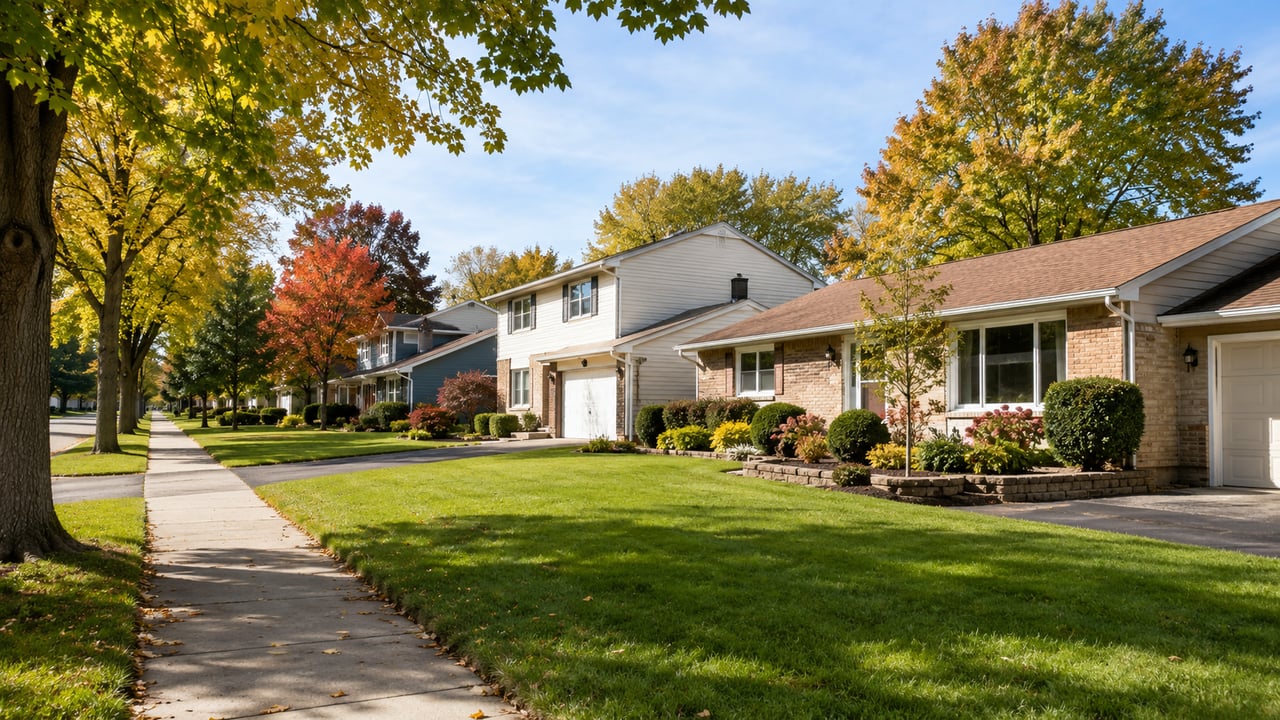
Elk Grove Village sits next to O'Hare International Airport in Cook County, with quick access to I-90, I-290, and Illinois Route 390. Most of the housing stock is mid-century: ranches, split-levels, and colonials built between the 1950s and 1970s, plus condo and townhome developments added mostly in the 1980s and 1990s.
Of the detached houses that sold here in the past year, the median year built was 1966, and more than half were single-story ranches. If you are picturing a brand new build, this is not that market. If you are looking for a single-level floor plan on a standard suburban lot with an attached garage, there is a lot of it here.
About 74.7% of housing units here are owner-occupied, according to U.S. Census QuickFacts for 2020–2024. Median monthly owner costs for households with a mortgage were $2,164 over that same period.
I lived in nearby Wood Dale for years, and the central location genuinely made a difference when my husband and I both had jobs scattered across the region. You can get almost anywhere from here.
One thing to check early: the village is close to O'Hare, and aircraft noise varies by neighborhood, weather, and flight path. Visit any home you are serious about at a few different times of day. Fifteen minutes on a Tuesday morning does not tell you what a Saturday evening sounds like.
What Do Homes Actually Cost in Elk Grove Village?
Here is what closed, not what was listed or estimated. These are local MLS figures for sales that closed between August 2025 and August 2026.
Property type | Closed sales | Median sale price | Middle 50% range | Median days on market |
|---|---|---|---|---|
Condos and townhomes | 149 | $289,900 | $229,130 – $340,000 | 18 |
Detached houses | 242 | $449,000 | $380,000 – $522,513 | 9 |
All residential | 391 | $380,000 | $308,950 – $475,000 | 11 |
That gap is the most important thing on this page. Most price reports for Elk Grove Village blend both categories into one number somewhere around $380,000, and that blended figure describes a home almost nobody actually buys.
Here is where the sales landed:
Price band | Condos/townhomes | Detached houses |
|---|---|---|
Under $250,000 | 54 | 0 |
$250,000 – $300,000 | 37 | 5 |
$300,000 – $350,000 | 28 | 21 |
$350,000 – $400,000 | 21 | 58 |
$400,000 – $450,000 | 6 | 42 |
$450,000 – $500,000 | 2 | 45 |
$500,000 – $600,000 | 0 | 39 |
$600,000 and up | 1 | 32 |
Two things stand out. If your budget tops out around $300,000, an attached home is your realistic path, and there are plenty of them. And if you want a detached house, about a third of them still sold under $400,000, so it is not out of reach either.
Year over year, the market has been steady rather than dramatic. Comparing the same February-to-August window in 2025 and 2026, the overall median was essentially flat, condo medians were flat at about $290,000, and detached medians rose from $426,500 to $457,450.
How Fast Do Homes Sell in Elk Grove Village?
Fast. The median detached house went under contract in 9 days and the median condo or townhome in 18 days. About 61% of detached houses were under contract within two weeks, and 67% sold at or above asking price.
Right now there are roughly 47 homes actively listed across the village, with about 42 more already under contract. That is not much inventory for a town of nearly 32,000 people.
What this means practically: you need your pre-approval finished, your agent lined up, and your must-haves decided before you start touring. The buyers who lose out here are usually not the ones who bid too low. They are the ones who were not ready to write when the right house appeared on a Thursday.
Why Your Tax Estimate Might Be Too Low This Year
This is the part most Elk Grove Village buying guides are missing right now, and it can cost you real money.
Elk Grove Township is part of Cook County's north suburban reassessment group, and it was reassessed in 2025. The Assessor released the new Elk Grove Township values on May 6, 2025. Those values are reflected on the tax bills going out in 2026. Separately, Cook County's second-installment bills have been running about two months behind schedule this year.
Put those together and you get a real trap for a 2026 buyer: the most recent bill you can look up may be a pre-reassessment bill. Budget off it and your escrow payment could jump after you move in.
What to do about it:
- Look up the property's PIN and full assessment history on the Cook County Assessor's website, not just the last bill amount.
- Check whether the current owner's bill includes exemptions you may not qualify for right away, like a senior exemption or senior freeze. Those can make a bill look far lower than what you will pay.
- Ask your lender to build the escrow estimate on the reassessed value, not the old bill.
- Have your attorney confirm the assessment status during attorney review.
For more on how the pieces fit together, read how property taxes work in Cook County.
For scale: among homes that sold in the past year, median annual property taxes were about $3,993 for attached homes (roughly $333 a month) and $7,119 for detached homes (roughly $593 a month), based on the most recent tax year reported in each listing. Treat those as a starting point, not a prediction for a specific address.
How Do You Build a Realistic Monthly Budget?
Most first-time buyers anchor on the mortgage payment and get surprised by everything else. Your real monthly number includes seven pieces.
Principal and interest. Depends on your loan amount, rate, and down payment. At the $289,900 attached-home median with 5% down, you would start with a loan around $275,405. At the $449,000 detached median with 5% down, closer to $426,550.
Property taxes. See the section above. This is the line item most likely to be wrong on a listing page.
Homeowners insurance. Get a real quote early, not a rule of thumb. Rates have moved a lot in the last few years.
Private mortgage insurance. If you put less than 20% down on a conventional loan, expect PMI in your payment until you reach enough equity to remove it. Ask your lender exactly when and how it comes off.
Association fees. Nearly every attached home here has them. Among condos and townhomes that sold in the past year, the median monthly assessment was $373, with most falling between $296 and $465. Before you commit, read what the fee covers, look at the association's reserves, and ask whether any special assessments are planned.
Utilities. Older housing stock means older windows, insulation, and mechanicals in some homes. Ask the seller for a year of utility history.
Maintenance and repairs. A 1966 ranch will need things. Set money aside monthly so the first surprise is an annoyance and not a crisis.
Knowing your comfortable monthly number, and your walk-away number, is what lets you move quickly without panicking.
What Loan Options and Down Payment Programs Can Help?
You likely have more options than you think, especially at the attached-home price point.
IHDAccess Home is the Illinois Housing Development Authority's current flagship program. It pairs a 30-year fixed-rate mortgage with up to $15,000 in down payment and closing cost assistance, structured as a 0% interest deferred second mortgage with no monthly payment. It is typically repaid only if you sell, refinance, or reach the 30-year mark.
At the $289,900 condo median, $15,000 covers more than a 5% down payment. That changes the math for a lot of people who assume they need to save for another two years.
There are income limits, purchase price limits, and other eligibility rules, and you have to work with an IHDA-participating lender. Start at IHDA Mortgage and read my fuller breakdown of IHDA down payment assistance in Illinois.
FHA loans allow qualified buyers to purchase with as little as 3.5% down, with more flexible credit requirements than most conventional loans. The tradeoff is mortgage insurance that, on most FHA loans, stays for the life of the loan. Ask your lender to run both options side by side.
Conventional loans with 3% or 5% down exist too, and for buyers with strong credit they sometimes beat FHA once PMI is factored in.
Whatever you choose, get a written pre-approval, not a pre-qualification. A pre-qualification is a conversation. A pre-approval means a lender has actually reviewed your income, assets, and credit. In a market where houses go in nine days, that difference decides who gets the house.
What Will You Find When You Start House Hunting?
Detached inventory is mostly ranches and two-stories from the 1950s through the 1970s, with a smaller number of split-levels and raised ranches. Attached inventory is mostly condos, with some fee-simple townhomes that carry an association.
Currently active listings run about $198,900 to $425,000 for attached homes and $364,900 to $1,200,000 for detached, with medians around $310,000 and $475,000 respectively.
Which school districts serve Elk Grove Village?
Elk Grove Village addresses fall into more than one district, and the rough dividing line is I-290. Addresses east of I-290 are generally served by Community Consolidated School District 59 and Township High School District 214. Addresses west of I-290 are generally served by School District 54 and Township High School District 211.
Boundaries do not follow the highway exactly, and a single subdivision can be split. Confirm the assigned schools for a specific address using the district's own boundary lookup or registration office before you write an offer. A listing sheet is not a reliable source for this, and neither is a real estate portal.
How do you get around?
Most residents drive. Elk Grove Village does not have its own Metra station. Pace Route 223 connects the village with the Rosemont CTA Blue Line station, which gets you to O'Hare and downtown Chicago, and Pace added weekend and midday trips to that route recently.
If transit is part of your plan, test the whole commute from the specific neighborhood you are considering, at the hour you would actually travel. Include the drive or bus to the station, parking, transfers, and the trip home. Mean travel time to work for Elk Grove Village residents is about 25.5 minutes, per Census data for 2020–2024, but that is an average across every kind of commute.
How Do You Write a Strong First Offer?
Price matters, but in a market this fast, the rest of the offer often decides it.
Earnest money. In Chicago's Northwest Suburbs, roughly 1% to 3% of the purchase price is customary. Your contract will spell out the amount, the delivery deadline, and who holds it.
Contingency timelines commonly seen locally:
- Inspection period: about 5 to 10 business days
- Mortgage commitment: about 21 to 30 days
- Closing: about 30 to 45 days after acceptance
These are negotiable and should match your lender's actual timeline and your attorney's guidance. Do not agree to a mortgage contingency your lender cannot meet just to look competitive.
Attorney review. Illinois contracts include a period for your attorney to review and propose changes. Have your attorney chosen before you write, not after your offer is accepted.
Ask about the seller's timing. When two offers are close, a closing date that solves the seller's problem can win the house. It costs you nothing to ask.
One more thing: with 67% of detached homes selling at or above list, going in at asking price is often the starting point here, not the aggressive move. Know your ceiling before you get emotionally attached.
What Should You Inspect?
Inspect everything you are serious about, including homes that look immaculate. For a fuller walkthrough, see my home inspection checklist for Chicago's Northwest Suburbs. For Elk Grove Village specifically, prioritize these.
General home inspection. Structure, roof, electrical, plumbing, HVAC, and major components. In a housing stock where the median detached home was built in 1966, pay particular attention to the electrical panel and service capacity, the age of the furnace and air conditioner, and any sign of water in the basement or crawl space.
Radon testing. Radon is an odorless, colorless gas that enters through the soil, and parts of Illinois have elevated levels. The EPA's radon resources explain zones and testing.
Here is what surprises people: Illinois law requires sellers to disclose known radon information and to give you two IEMA pamphlets before you sign, but it does not require sellers to test or to fix anything. Testing is on you.
If levels come back high, mitigation is a solvable problem. Contractor estimates in Illinois generally run from about $1,000 to $2,500, with complex installations costing more.
Sewer scope. On a home from the 1950s or 1960s, a camera inspection of the sewer line is money well spent. Tree roots and clay pipe are common in housing of this age, and a failed line is a five-figure surprise.
Aircraft noise. Go back at different times and days before your inspection contingency expires.
Association documents, if applicable. For a condo or townhome, review the budget, reserves, meeting minutes, and any pending special assessments during your review period.
What Are Closing Costs, and How Does Closing Work in Illinois?
Your lender orders an appraisal to confirm the home supports the loan amount. A title company handles the title search and coordinates the closing table.
Buyer closing costs commonly run about 2% to 6% of the purchase price. At the $289,900 attached median, that is roughly $5,800 to $17,400. At the $449,000 detached median, roughly $8,980 to $26,940. Your lender's Loan Estimate is the real number.
Typical components:
- Loan origination and lender fees
- Appraisal
- Title and settlement charges
- Prepaid property taxes and homeowners insurance
- Initial escrow reserves
Two documents matter most. Your Loan Estimate arrives early in the process with the projected rate, payment, and costs. Your Closing Disclosure arrives at least three business days before closing with the final numbers.
Compare them line by line. If something moved, ask why before you sign. You should understand where every number comes from.
What Happens After You Get the Keys?
The first week has a short list that is easy to forget while you are surrounded by boxes.
- Transfer utilities and confirm trash and recycling service.
- Confirm your first mortgage payment date and your escrow setup.
- File for the homeowner exemption with the Cook County Assessor. This is not automatic for a new owner and it directly lowers your bill.
- Store your recorded deed, owner's title policy, inspection report, survey, and closing documents somewhere you will find them in five years.
- Change the exterior locks and update the garage door codes.
That exemption filing is the one people skip. Do it.
A Few Smart Moves in Any Market
Prices, rates, and inventory will keep changing. These hold up regardless.
- Get fully pre-approved before you tour anything seriously.
- Know your comfortable monthly payment and your walk-away number, in writing, before you fall in love with a house.
- Build your tax estimate on the reassessed value, not last year's bill.
- Use your inspection period. Ask questions. It is not rude.
- Submit clean, complete offer paperwork with clear timelines. In a nine-day market, a sloppy offer loses to an organized one.
For a wider look at the area, read my guide to living in Chicago's Northwest Suburbs, which covers Arlington Heights, Palatine, Schaumburg, Mount Prospect, and Elk Grove Village.
Follow-Up Questions
How much do you need to buy a first home in Elk Grove Village?
It depends on the type of home. Over the past twelve months, condos and townhomes sold at a median of $289,900 and detached houses at a median of $449,000. With IHDAccess Home assistance of up to $15,000, a 5% down payment on a median condo is within reach for many first-time buyers.
How fast do homes sell in Elk Grove Village?
Very fast. Median market time over the past year was 9 days for detached houses and 18 days for condos and townhomes. About 67% of detached houses sold at or above asking price. Have your pre-approval and your priorities settled before you start touring.
Why might my Elk Grove Village property tax estimate be too low?
Elk Grove Township was reassessed in 2025, and those values appear on tax bills issued in 2026. A prior-year bill may reflect pre-reassessment values, and the current owner may hold exemptions you will not qualify for. Verify the PIN and assessment history with the Cook County Assessor.
Which school districts serve Elk Grove Village?
Addresses fall into different districts depending on location, roughly split by I-290. East of I-290 is generally District 59 for elementary and middle school and District 214 for high school. West of I-290 is generally District 54 and District 211. Boundaries do not follow the highway exactly, so confirm by address with the district itself.
Does Elk Grove Village have public transportation?
There is no Metra station in the village. Pace Route 223 connects Elk Grove Village to the Rosemont CTA Blue Line station, with service to O'Hare and downtown Chicago. Most residents drive. Mean commute time is about 25.5 minutes, per Census data for 2020–2024.
Do sellers in Illinois have to test for radon?
No. Illinois requires sellers to disclose known radon information and provide two IEMA pamphlets before the contract is signed, but it does not require testing or mitigation. Order your own test during the inspection period. Mitigation, if needed, generally runs about $1,000 to $2,500.
What are HOA fees like for condos in Elk Grove Village?
Among condos and townhomes that sold in the past year, the median monthly assessment was $373, with most between $296 and $465. Fees vary by what they cover. Review the association's budget, reserves, and any planned special assessments before your inspection contingency expires.
Market data source: ConnectMLS, Elk Grove Village closed detached and attached residential sales, August 2025 through August 2026 (n = 391). Property tax figures reflect the most recent tax year reported in each listing. Data deemed reliable but not guaranteed.
Equal Housing Opportunity. Mari and the Dragonfly Home Team at Berkshire Hathaway HomeServices American Heritage Real Estate are committed to full compliance with the federal Fair Housing Act and the Illinois Human Rights Act. Housing services are provided without regard to race, color, religion, sex, disability, familial status, national origin, ancestry, age, marital status, sexual orientation, gender identity, military status, order of protection status, pregnancy, or source of income. This article is general education, not legal, tax, or financial advice. Market data reflects a specific time period and will change. For guidance on your own situation, please consult a licensed attorney, tax professional, or lender.