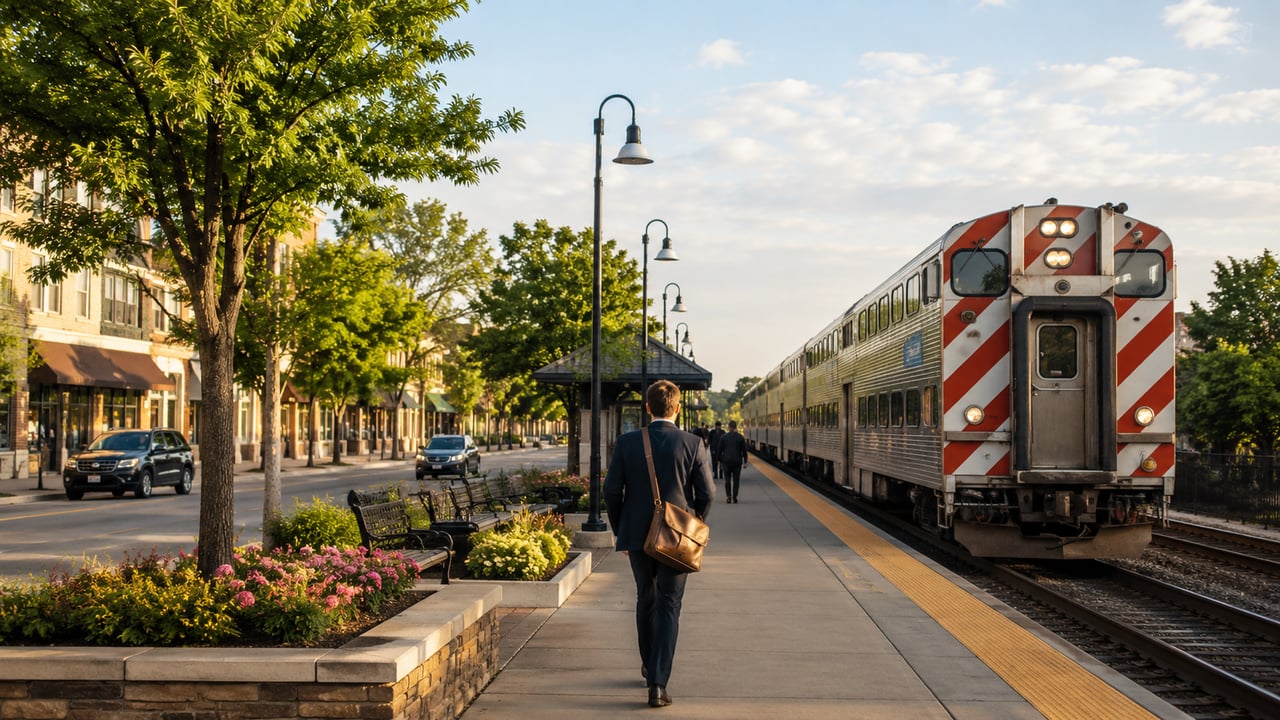
The train from Mount Prospect to downtown Chicago takes about 35 minutes on the fastest runs and 46 to 48 on all-stop locals, covering 20 miles to Ogilvie Transportation Center on Metra's Union Pacific Northwest Line. Daily station parking is $2. Driving at peak hour takes longer and is far less predictable.
Key Takeaways
- The Mount Prospect Metra station is on the Union Pacific Northwest (UP-NW) Line, 20.0 miles from Ogilvie Transportation Center, in fare Zone 3.
- Inbound weekday trips run about 35 minutes on the fastest trains and 46 to 48 minutes on all-stop locals. Most trains are closer to 46.
- The station has 652 parking spaces across 9 lots, including 229 for daily parking, at $2 per day. A monthly permit is $40.
- Lots are free to the public 6 p.m. to 2 a.m. on weekdays and all day on weekends.
- As of Metra's 2018 counts, Mount Prospect was the 11th busiest of 236 non-downtown stations, averaging about 1,879 weekday boardings.
- Pace Route 234 connects to the station for riders who don't want to park.
- O'Hare proximity matters more than the Loop commute for a meaningful share of local households.
How Long Is the Train From Mount Prospect to Chicago?
About 35 minutes on the fastest trains and 46 to 48 minutes on all-stop locals. Most trains fall at the slower end.
The Mount Prospect station sits in the middle of downtown Mount Prospect on the UP-NW Line, which runs from Ogilvie Transportation Center out to Harvard, with a branch to McHenry.
A few real examples from the current timetable: the 9:24 a.m. inbound reaches Ogilvie at 10:10, a 46-minute ride. The 4:54 a.m. gets in at 5:42, 48 minutes. The 8:54 a.m. makes it in 35.
The spread matters more than the average. If your schedule lines up with a faster train, the commute is genuinely easy. If you're stuck with a local that stops everywhere, you're adding a little over ten minutes each way.
Before you commit to a house based on the commute, pull up the current UP-NW schedule and find the specific trains that match your actual work hours. Look at what's available at 7:10 a.m., not what's available at 6:40 a.m. if you'd never catch that.
For context on how that compares nearby: Palatine sits 26.8 miles out on the same line, and on trains serving both stations, Palatine riders are aboard 12 minutes longer inbound and 13 longer outbound. Our Mount Prospect vs Palatine comparison works through what that costs over a year.
One more thing worth knowing: Mount Prospect is a well-used station. Metra's 2018 counts put it 11th busiest out of 236 non-downtown stations, at roughly 1,879 average weekday boardings. Those are the most recent rankings I've been able to confirm, and ridership patterns shifted after 2020, so treat the number as directional. The practical takeaway holds either way: the lot fills up.
How Much Does Metra Parking Cost in Mount Prospect?
Daily parking is $2.00. A monthly permit is $40. The station has 652 total spaces across 9 lots, with 229 designated for daily parking and 12 ADA spaces. Paid hours run weekdays; lots are free to the public from 6 p.m. to 2 a.m. on weekdays and all day Saturday and Sunday.
Now here's the part almost nobody works out, and it's worth two minutes.
At $2 a day, a five-day commuter spends roughly $42 a month on daily parking. The permit is $40. That's a difference of about two dollars.
So the permit isn't really a cost decision. It's a certainty decision. You're paying $40 for a guaranteed space instead of $42 for a daily gamble on whether one is left.
And if you're hybrid, going in three days a week, daily parking costs about $26 a month and the permit stops making sense at all. The waitlist that worries a lot of buyers matters far less than they think unless they're commuting five days.
Verify current rates with the Village of Mount Prospect before you count on them, since these change.
Availability is the real question. On a busy station with a limited daily allotment, spaces go early. If you plan to drive and park every day, three things are worth doing before you buy:
- Ask the Village about the permit waitlist and how long it currently runs
- Drive past the lot around 8:15 a.m. on a Tuesday and see what's actually left
- Price out the alternative if parking doesn't work
For how a neighboring town handles the same problem, our guide to Palatine Metra station parking covers the permit-versus-daily tradeoff in more depth.
Is It Worth Living Within Walking Distance of the Metra Station?
It depends almost entirely on how many days a week you'd actually walk to it. This is the piece that most affects home values in Mount Prospect, and it's worth thinking about deliberately rather than by instinct.
Homes within comfortable walking distance of the downtown station sidestep the parking question entirely. No permit waitlist, no daily fee, no circling the lot at 7:50 a.m. You walk out your door and you're on the platform.
That convenience is priced in. In my experience, walkable-to-station blocks in Mount Prospect draw a deeper and more consistent buyer pool than comparable homes further out, and that tends to show up in both price and time on market.
Whether the premium is worth paying comes down to usage. Two or three days a week of hybrid commuting changes the math considerably against five. Buyers sometimes pay for daily walkability and then use it twice a month.
The Mount Prospect neighborhood guide breaks down which areas sit in that walking radius.
Should I Drive or Take the Train to Downtown Chicago?
Take the train. You can drive it. Most people don't do it twice.
Mount Prospect to the Loop is roughly 22 to 25 miles by car depending on your route, typically I-90 or a combination of surface roads to I-294 and then in. At 10 p.m. on a Sunday, that's a pleasant half-hour drive.
At 7:30 a.m. on a Wednesday, it is not. Peak-hour drive times to the Loop routinely run well past what the train takes, and unlike the train, the number is unpredictable. A bad accident on the Kennedy can turn a 50-minute drive into a 90-minute one with no warning.
Then there's parking, which in the Loop can easily exceed the cost of a monthly Metra pass on its own.
The practical read: if you work downtown regularly, Mount Prospect works because of the train, not despite the drive. If the train doesn't fit your schedule, look hard at whether this commute is one you want.
For a broader comparison across the region, see best Chicago suburbs for commuters.
How Close Is Mount Prospect to O'Hare?
Close enough that reaching a terminal is a short drive rather than a trip. For a meaningful share of Mount Prospect households, the Loop commute isn't the relevant one. O'Hare is.
The airport sits near enough that Mount Prospect works as a practical base for flight crews, frequent business travelers, and the large employment base clustered around the airport and Elk Grove Village. That's worth real money if you fly weekly.
The tradeoff is honest: proximity means aircraft noise on certain streets, and it varies by flight path and runway configuration rather than by neighborhood in any neat way. If noise sensitivity is a factor, visit a specific address at different times of day before you commit. Do not rely on a general impression of the town.
Our guide to getting to O'Hare from the Northwest Suburbs covers realistic timing and rideshare costs.
Can You Live in Mount Prospect Without a Car?
In the right location, one car instead of two is realistic. Fully car-free is a stretch.
Pace Route 234 serves the Mount Prospect station, which gives non-drivers a way to reach the train. Combine that with a walkable downtown and a well-served Metra station and a one-car household works in the right spot.
But Mount Prospect is not a car-free suburb in the way that parts of Des Plaines near the Blue Line can be. Commuter rail is built around peak hours. Miss the last useful train and your options narrow quickly.
If genuinely car-light living is the goal, it's worth comparing against southern Des Plaines and its CTA Blue Line access, which offers something Mount Prospect doesn't: rapid transit running all day rather than service built around rush hour.
Is Mount Prospect a Good Town for Commuters?
Yes, and it's underrated relative to towns with louder reputations.
Being 20 miles out on the UP-NW rather than 27 is a structural advantage no amount of amenities elsewhere can offset. Add $2 daily parking, a walkable downtown around the station, and O'Hare proximity, and the transportation package is genuinely strong.
The weak spot is parking capacity relative to demand, which is solvable if you buy in the right spot or plan around it.
If you're deciding between here and the town next door, Arlington Heights vs Mount Prospect compares them directly. For the bigger picture on the village, start with our complete guide to living in Mount Prospect.
Want Help Figuring Out If the Commute Works?
A commute looks fine on a map and feels different at 6:45 a.m.
Tell me your work schedule and I'll tell you which blocks actually work. Walking distance to the platform, which streets sit under a flight path, whether the train that matches your hours is a 35-minute run or a 46-minute one. That's a short conversation and it saves people from buying a commute they didn't sign up for.
Book a call at tinyurl.com/talk2mari
If you'd rather look around first, I share neighborhood tours and local updates on Life in the NW Burbs. Email works too: [email protected]. The full guide library is at MyRealtorMari.com.
Common Questions About Commuting From Mount Prospect
How long is the train from Mount Prospect to Chicago?
About 35 minutes on the fastest trains and 46 to 48 minutes on all-stop locals, with most trains closer to 46. The station is 20.0 miles from Ogilvie Transportation Center on the Union Pacific Northwest Line.
How much does Metra parking cost in Mount Prospect?
Daily parking is $2.00 and a monthly permit is $40. The station has 652 spaces across 9 lots, with 229 designated for daily parking. Lots are free to the public from 6 p.m. to 2 a.m. weekdays and all day on weekends.
Which Metra line serves Mount Prospect?
Mount Prospect is served by Metra's Union Pacific Northwest (UP-NW) Line, running between Ogilvie Transportation Center and Harvard, with a branch to McHenry. The station sits in downtown Mount Prospect in fare Zone 3 and connects to Pace Route 234.
Is Mount Prospect close to O'Hare Airport?
Yes. Mount Prospect sits just northwest of O'Hare International Airport, close enough that reaching a terminal is a short drive. That proximity is a major convenience for frequent travelers, though some streets experience aircraft noise depending on flight paths.
Is it better to drive or take the train from Mount Prospect to downtown Chicago?
The train, for regular commuting. Driving covers roughly 22 to 25 miles, but peak-hour times run long and unpredictable, and Loop parking often costs more than a monthly Metra pass on its own.
Should I buy a Metra parking permit in Mount Prospect?
Only if you commute five days a week. At $2 a day, five days costs about $42 a month against a $40 permit, so the permit buys certainty rather than savings. At three days a week, daily parking runs about $26 and the permit isn't worth it.
About the Author
Mari Van Meter is a REALTOR® with the Dragonfly Home Team at Berkshire Hathaway HomeServices American Heritage Real Estate, serving Mount Prospect, Arlington Heights, Palatine, Buffalo Grove, Wheeling, and the surrounding Northwest Suburbs of Chicago. She holds the C2EX, SRES, PSA, and ABR designations. Most of her clients are in the middle of something, a divorce, a downsize, a relocation, and she's found that the practical questions like where the train stops and what parking costs are often what finally makes a hard decision feel manageable. More at MyRealtorMari.com and about Mari.