Arlington Heights is one of the most popular communities in Chicago’s Northwest Suburbs, and it is easy to understand why. It has a walkable downtown, respected public schools, and direct Metra access to Chicago.
It also comes with real trade-offs. Property taxes are high, limited inventory can make buying stressful, and a few local rules may surprise people after they move in.
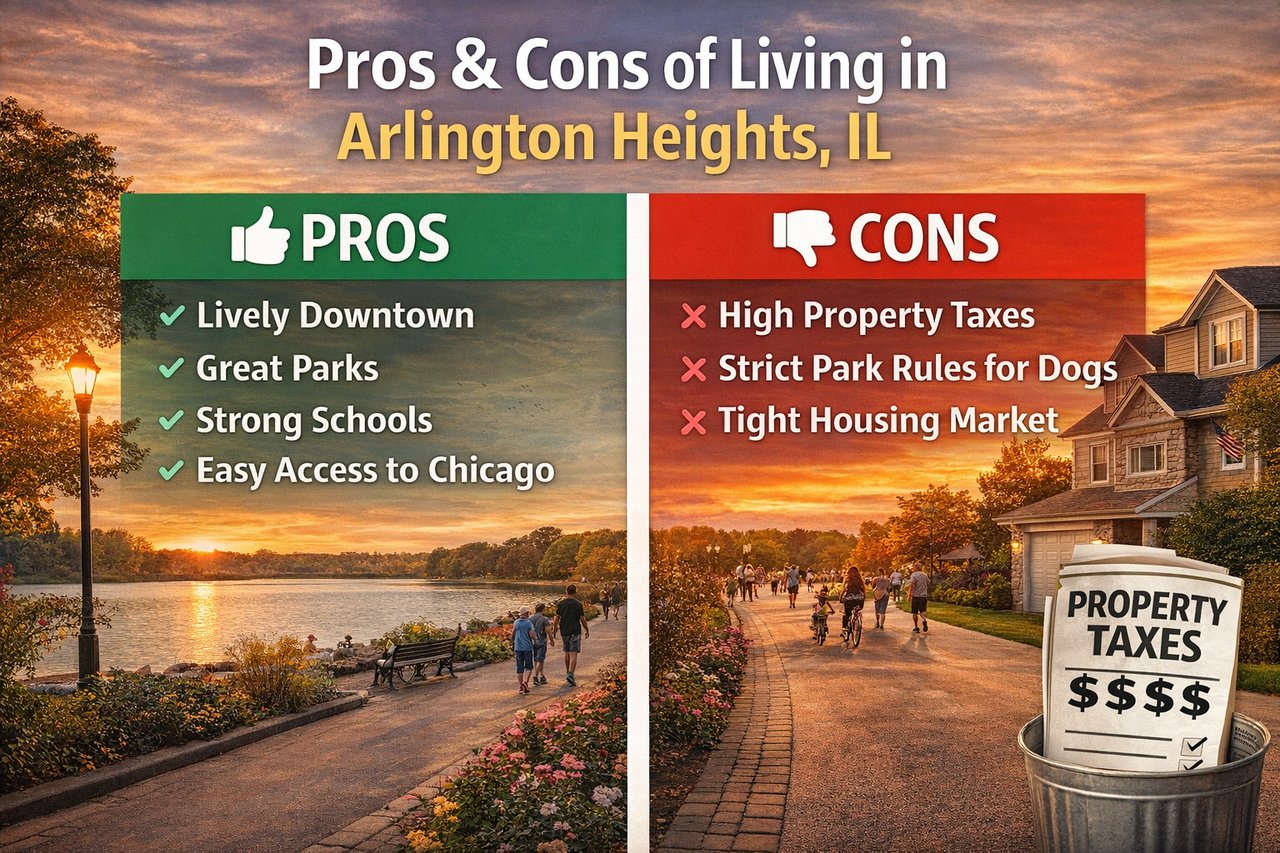
Key Takeaways
- Arlington Heights has an active suburban downtown with restaurants, live performances, shops, and walkable streets.
- The Metra Union Pacific Northwest Line connects downtown Arlington Heights with Chicago’s Ogilvie Transportation Center in approximately 35 to 45 minutes.
- Much of Arlington Heights is served by Arlington Heights School District 25 and Township High School District 214, although school assignments vary by address.
- Property taxes may run approximately 2.0% to 2.4% of market value, which is high compared with many parts of the country but consistent with nearby Cook County suburbs.
- Homes near downtown, parks, and popular school districts can sell quickly, so buyers should prepare before beginning their search.
- Dogs are not allowed at Lake Arlington. Canine Commons Dog Park at Melas Park is a nearby off-leash option that requires registration and a membership fee.
The Honest Version
Every community sounds good in a brochure. What really helps you decide is understanding both the things people love and the details that can catch them off guard.
I live in Arlington Heights, and one of the things I appreciate most is how much people use the community. On an ordinary weekday morning, you will see people walking, biking, visiting local businesses, and spending time in the parks.
That everyday activity tells you something. Arlington Heights is not simply a place where people sleep and commute. It feels connected and lived in.
I also hear the questions that come up when buyers begin looking closely at home prices, taxes, commute times, and local rules. Here is a straightforward look at the advantages and trade-offs.
Pro: A Downtown That Feels Active
This is one of the first things people notice when they visit.
Arlington Heights has a true town center. Restaurants, shops, entertainment, and the Metra station are concentrated around Vail Avenue, Campbell Street, and Northwest Highway.
On warm evenings, the patios are busy and people gather downtown for dinner, coffee, live music, and community events. The Metropolis Performing Arts Centre brings theater and live performances into the center of the village.
During Arlington Alfresco, part of Vail Avenue becomes a pedestrian-focused outdoor dining area. It gives downtown a lively atmosphere throughout the warmer months.
For people relocating from Chicago, downtown Arlington Heights can make suburban life feel less disconnected. You may have more space and a quieter neighborhood without giving up restaurants, events, or the ability to walk somewhere for dinner.
Con: Property Taxes Are High
This concern comes up often, and it deserves a clear answer.
Property taxes in Arlington Heights may run approximately 2.0% to 2.4% of market value. On a $600,000 home, that could mean an annual bill of roughly $12,000 to $14,400.
For buyers coming from another state or county, that difference can be significant.
Property taxes help fund the school districts, park system, Arlington Heights Memorial Library, and Village services. Those amenities are part of what attracts people to the community, but the cost still needs to fit comfortably within your budget.
Before becoming attached to a home, look at the full monthly payment. Include principal, interest, property taxes, homeowners insurance, association fees, and private mortgage insurance when applicable.
For a more detailed explanation, read my guide to how Cook County property taxes work.
Pro: Respected Public Schools
Schools are one reason many buyers include Arlington Heights in their search.
Much of the village is served by Arlington Heights School District 25 for elementary and middle school and Township High School District 214 for high school.
Other school districts also serve portions of Arlington Heights, so the assigned schools can vary by neighborhood and even by street. Always confirm the attendance boundaries directly with the district for the specific property address.
District 214 offers AP, honors, dual-credit, career pathway, and college preparation programs across its high schools. Buyers should review current programs, enrollment information, and performance data directly with the district and the Illinois Report Card.
Even buyers without school-age children may consider school district boundaries because they can affect buyer demand and future resale.
Con: Dog Rules May Be Different Than You Expect
This can surprise people who assume every park will be open to dogs.
Dogs are allowed in many Arlington Heights parks, but they generally need to remain on a leash unless they are inside a designated off-leash area.
Dogs are not allowed at Lake Arlington, even though it is one of the village’s most popular places for walking and outdoor recreation.
A nearby off-leash option is Canine Commons Dog Park at Melas Park, which is operated jointly by the Arlington Heights and Mount Prospect Park Districts. The park includes separate areas for large and small dogs, but registration and a membership fee are required.
A few other things to know:
- Dogs must remain on a leash in public parks unless they are in a designated off-leash area.
- Owners are responsible for cleaning up after their pets.
- Dogs are allowed at the Arlington Heights Farmers Market but must remain on a short leash.
- Individual parks and events may have additional restrictions, so review posted signs and current park district rules.
These rules are not unusual for a suburban park system, but they are worth understanding before you choose a neighborhood based on nearby outdoor amenities.
Pro: Convenient Access to Chicago and O’Hare
Location is one of Arlington Heights’ strongest advantages.
The Metra Union Pacific Northwest Line runs through downtown Arlington Heights. The station is located near Northwest Highway, restaurants, businesses, condominiums, and residential streets.
A typical train trip to Chicago’s Ogilvie Transportation Center takes approximately 35 to 45 minutes, depending on the train and schedule.
This can be a good fit for someone who wants more space in the suburbs but still needs regular access to downtown Chicago.
Arlington Heights is also close to O’Hare International Airport. The airport is approximately 10 miles away, and the drive may take 15 to 20 minutes in lighter traffic.
Driving to downtown Chicago commonly takes 45 to 75 minutes, depending on traffic, weather, and time of day.
Con: Desirable Homes Can Sell Quickly
Arlington Heights continues to attract buyers, and inventory can be limited in popular areas.
Well-priced homes near downtown, parks, transportation, or sought-after school districts may receive strong interest soon after they are listed.
Buyers who begin searching without a written pre-approval, a clear budget, or a list of priorities may find the process frustrating. They may also feel pressured to make decisions before they are ready.
Preparation helps. Know your comfortable monthly payment, have your pre-approval updated, and understand which features are essential before scheduling showings.
Moving quickly does not mean skipping important protections. Buyers should still review disclosures, complete inspections, and work with their attorney and lender before closing.
For more guidance, read my overview of what to inspect before buying a home in the Northwest Suburbs.
Is Arlington Heights Worth It?
That depends on what matters most to you.
Arlington Heights offers a combination that can be difficult to find in one community: an active downtown, direct Metra service, established neighborhoods, parks, local programs, and a wide range of housing styles.
The trade-offs are real. Property taxes are high. Desirable homes may sell quickly. Some parts of the village are car-dependent, and local dog rules may not work for everyone.
The goal is not to decide whether Arlington Heights is universally good or bad. It is to decide whether its strengths fit your daily life and whether the trade-offs fit your budget and priorities.
Spend time in the community before making that decision. Walk downtown, test your commute, drive through several neighborhoods, and visit the parks and businesses you would actually use.
For a deeper look at neighborhoods, home prices, commuting, and daily life, read my complete guide to living in Arlington Heights.
You can also compare the area with nearby communities in my Northwest Chicago suburbs comparison guide.
Want to Learn More Before You Decide?
Choosing a community is about more than comparing home prices. Your commute, budget, routines, hobbies, and plans for the next several years all matter.
I share neighborhood tours, community information, and relocation guidance on my YouTube channel, Life in the NW Burbs.
Schedule a consultation to talk through whether Arlington Heights fits your plans.
You can also email [email protected] or visit MyRealtorMari.com.
FAQs
Is Arlington Heights a good place to live?
Arlington Heights offers an active downtown, established neighborhoods, parks, public transportation, local programs, and a range of housing choices. Whether it is right for you depends on your budget, commute, preferred neighborhood style, and daily routine.
How far is Arlington Heights from downtown Chicago?
Arlington Heights is approximately 25 miles northwest of downtown Chicago. The Metra Union Pacific Northwest Line connects the downtown Arlington Heights station with Ogilvie Transportation Center in approximately 35 to 45 minutes. Driving may take 45 to 75 minutes, depending on traffic.
What are the biggest drawbacks of living in Arlington Heights?
Common concerns include property taxes, competitive housing inventory, and car dependence outside the downtown area. Buyers should also review school boundaries, commute times, and local park rules before choosing a neighborhood.
Are dogs allowed in Arlington Heights parks?
Dogs are allowed in many Arlington Heights parks but generally must remain on a leash. Dogs are not permitted at Lake Arlington. Canine Commons Dog Park at Melas Park is a nearby off-leash option that requires registration and a membership fee.
What is Arlington Heights known for?
Arlington Heights is known for its downtown restaurant and entertainment district, Metra access, established neighborhoods, parks, community programs, and local events such as Arlington Alfresco and the Arlington Heights Farmers Market.
How do Arlington Heights property taxes compare with nearby suburbs?
Arlington Heights property taxes are generally consistent with other Cook County communities in the Northwest Suburbs. The actual bill depends on the property’s assessed value, exemptions, and taxing districts, so buyers should review the current tax record for each home rather than relying on a broad percentage alone.