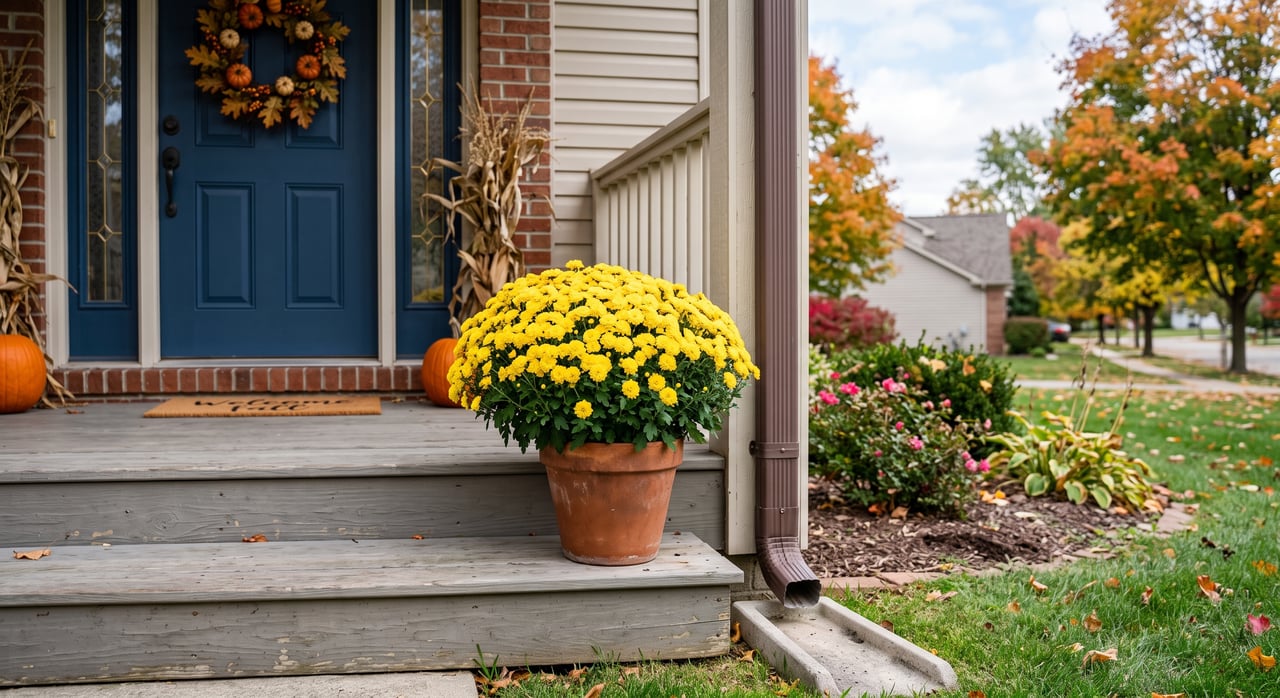
The average first freeze in the Chicago suburbs arrives around October 19, based on National Weather Service normals for O'Hare. Before then, disconnect and drain outdoor hoses, shut off the valves feeding outdoor spigots, blow out irrigation lines, clear gutters, test the sump pump, and have the furnace serviced.
Key Takeaways
- The average first 32°F freeze at O'Hare is October 19, using 1991 to 2020 climate normals (National Weather Service Chicago). Rockford averages October 13, so the far northwest edge of the region usually goes first.
- Frozen pipes are expensive here specifically. From 2024 through June 2025, State Farm paid more than $628 million on over 20,000 frozen pipe claims, with an average payment above $30,000. Illinois ranked first among all states by total claim costs (State Farm).
- The single most valuable ten minutes is finding your main water shut-off valve and making sure it turns.
- Illinois law requires a carbon monoxide alarm within 15 feet of every room used for sleeping in homes that burn fossil fuel or have an attached enclosed garage (Illinois State Fire Marshal).
- Any new smoke alarm you buy in Illinois must have a 10-year sealed battery, under a law effective January 1, 2023 (Illinois State Fire Marshal).
- Arlington Heights collects landscape waste through December 18, 2026, with a fall two-bags-for-one-sticker leaf program running October 19 through December 18. Other villages set their own dates, so check yours.
- Most of this is two Saturdays of work. None of it requires a contractor except the furnace.
When is the first freeze in the Chicago suburbs?
Around October 19. That is the average date O'Hare first drops to 32°F, using the 1991 to 2020 climate normals published by the National Weather Service Chicago office. Rockford averages October 13.
Average means half the years come earlier. A mid-October cold snap is completely ordinary here, and a late-September frost is not unheard of.
So the working deadline for everything below is the first weekend of October. That gives you a two-week cushion on the average, which is about right for a region where the first freeze and the first hard freeze are often only a few days apart.
One more thing worth knowing about our specific climate. The Chicago area does not freeze once and stay frozen. It cycles. Water gets into a crack in the driveway, freezes, expands, thaws, and does it again. That freeze-thaw pattern is why concrete, asphalt, tuckpointing, and roof flashing take a beating here in a way they do not in colder but steadier places.
What should I do outside before the first freeze?
Six things, and they all live outdoors. Start here, because outdoor water is what actually breaks.
1. Disconnect every hose
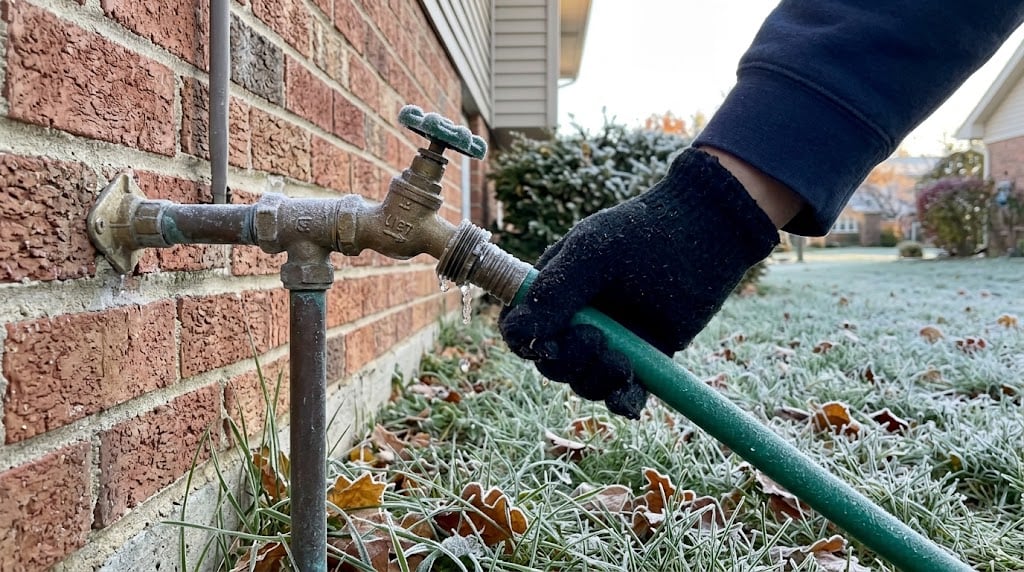
Pull the hose off the spigot, drain it, and coil it in the garage or shed.
A hose left attached traps water against the spigot. When that water freezes and expands, the split usually happens in the pipe inside your wall, not at the fitting you can see. You often find out in April.
Check the back of the house, the side yard, the deck, and the garage. Most people find a hose they forgot about.
2. Shut off the water to the outdoor spigots
Go to the basement or crawl space and look for a small valve on the pipe that feeds each outdoor spigot. Close it, then go outside and open the spigot to let the leftover water drain out. Leave it open for the winter.
If you have frost-free hose bibs, they drain themselves as long as the hose is off and the spigot is closed. That last part matters. A frost-free spigot with a hose attached is not frost-free.
Not sure which kind you have? Turn it off from inside anyway. There is no downside.
3. Have the sprinkler system blown out
If you have in-ground irrigation, it needs compressed air run through it to clear the lines. This is the one outdoor job that genuinely needs equipment most homeowners do not own.
Call in September. Irrigation companies book solid through the first two weeks of October, and the ones who wait for a freeze warning to call are the ones paying for repairs in the spring.
4. Clear the gutters and check the downspouts
Wait until most of the leaves are down, then clear them out. In the Northwest Suburbs, that usually means late October, which is after the first freeze. That is fine. Gutters are about ice dams in January, not the first frost.
What does need attention now: make sure downspouts carry water at least a few feet from the foundation and are not dumping onto a walkway where it will refreeze into a sheet of ice.
If getting on a ladder is not something you want to do, hire it out. This is a common seasonal service and it is not expensive relative to what a plugged gutter costs.
5. Test the sump pump and look at where it discharges
Pour a couple of gallons of water into the sump pit. The pump should kick on, move the water, and shut off.
Then walk outside and find where the discharge line ends. If it dumps right next to the foundation, that water can freeze, back up into the line, and leave the pump running against a plug of ice. Extend it away from the house.
While you are there, check the battery backup if you have one. Batteries are usually good for three to five years, and the failure mode is that you find out during a February thaw at two in the morning.
6. Walk the perimeter
Ten minutes, notebook in hand. Look for cracked concrete, gaps in caulk around windows and doors, missing weatherstripping on the garage door, and window wells full of leaves. Note anything you can seal in an afternoon.
Trim any branches hanging over the roof or the driveway. Ice storms make heavy branches heavier.
How do I keep my pipes from freezing in Illinois?
Keep the outdoor water out, keep the indoor heat in, and know where your shut-off valve is. That covers most of it.
Here is why this deserves more than a bullet point. From 2024 through June 2025, State Farm alone handled more than 20,000 frozen pipe claims and paid over $628 million on them. The average claim payment was more than $30,000. Illinois ranked first among all fifty states by total claim costs (State Farm).
That is not a scare statistic. It is a description of what our housing stock and our winters do together.
Find your main water shut-off valve now
Do this today, before you do anything else on this list.
In most Northwest Suburbs homes, the main shut-off is in the basement or a utility room, on the wall where the water line comes in from the street, usually near the meter. Turn it a quarter turn to make sure it is not seized. Then put a tag on it, and make sure everyone in the house knows where it is.
If a pipe bursts, the difference between knowing where that valve is and hunting for it is the difference between a wet floor and a finished basement.
What the Village of Palatine recommends
Palatine's Public Works department publishes clear guidance that applies across the region (Village of Palatine):
- Disconnect the garden hose and turn off the water to the spigot.
- Open cabinet doors under kitchen and bathroom sinks, especially on exterior walls, so warm air reaches the pipes.
- Let vulnerable faucets drip slowly during a deep cold stretch. Moving water is much harder to freeze.
- Do not leave the garage door open for long stretches if your water meter is in or near the garage.
- If you travel, have someone check that the heat is still on. A furnace that quits while you are away is how most winter water damage starts.
If a pipe does freeze
Open the faucet and warm the pipe with a hair dryer, working from the faucet end back. Palatine is explicit about the other thing: never use a blowtorch or any open flame. That is how a frozen pipe becomes a house fire.
If a pipe bursts, shut the water off at the main, leave the faucets open, and call a plumber. Palatine residents can reach Public Works at (847) 705-5200; other villages have their own numbers, and it is worth having yours in your phone before you need it.
Pipes that need extra attention in older homes
Much of the Northwest Suburbs housing stock was built between the 1950s and the 1980s. In homes from that era, these are the usual suspects:
- Pipes running through an unheated crawl space
- Plumbing in an exterior wall, especially in a kitchen or bath that was added later
- A bathroom over an unheated garage
- Anything in a garage, a detached workshop, or a three-season room
Foam pipe sleeves cost a few dollars a length and go on in minutes. It is the cheapest insurance on this entire list.
Should I have my furnace serviced before winter?
Yes, and September or early October is the right time to call. Once the first cold night hits, HVAC companies switch to emergency calls and a routine tune-up moves to the back of the line.
Nicor Gas recommends having your heating system, water heater, and any other natural gas appliances checked and serviced yearly by a qualified licensed professional (Nicor Gas).
What you can do yourself in the meantime:
Change the filter. Then set a reminder to do it again in January. A clogged filter makes the furnace work harder and run longer.
Run the heat for fifteen minutes now. Turn the thermostat up on a mild day and let it cycle. You want to find the problem in September, when it is an appointment, not in January, when it is an emergency.
Expect a smell the first time. Dust burning off the heat exchanger is normal and passes in a few minutes. A smell that keeps going, or any smell of gas, means shut it down and call.
Clear the space around the furnace. Boxes and storage stacked against it are both an airflow problem and a fire problem.
Check the vent. High-efficiency furnaces and power-vented water heaters vent through a PVC pipe out the side wall, often close to the ground. Nicor is specific that this pipe has to stay clear of ice and snow. Know where yours is now, in daylight, so you are not looking for it in a snowstorm.
And on the gas meter: when snow piles up, Nicor says to use your hands or a broom, never a shovel, since shovels and other tools can damage the equipment.
One safety rule with no exceptions. Nicor states it plainly: never use an oven or stove burners to heat your home. They are not designed for it and they produce carbon monoxide.
Are my smoke and carbon monoxide alarms up to Illinois code?
This is the item people skip, and it is the one with an actual legal requirement attached. Heating season is when carbon monoxide risk goes up, so it belongs on the pre-freeze list.
Carbon monoxide alarms
Illinois law requires a carbon monoxide alarm within 15 feet of every room used for sleeping. The requirement applies to homes that use fossil fuel for cooking, heating, or hot water, or that are connected to an enclosed garage. The alarm must be battery-operated, plug-in with battery backup, or hardwired with battery backup, and certified by a recognized testing laboratory. This comes from Public Act 094-0741, effective January 1, 2007 (Illinois State Fire Marshal).
Nearly every house in the Northwest Suburbs meets one of those conditions. If you have a gas furnace, a gas water heater, a gas range, or an attached garage, this applies to you.
CO alarms also expire. Most have a service life of five to ten years and print the date on the back. Check yours.
Smoke alarms
Since January 1, 2023, new smoke alarms installed in Illinois homes must have a 10-year sealed battery. Alarms installed before that date can stay until they hit ten years old, fail a test, or malfunction. Homes built after 1988 with hardwired alarms are exempt, as are homes with wireless integrated alarms (Illinois State Fire Marshal).
Practically: press the test button on every alarm in the house this weekend. If one is more than ten years old, replace it, and the replacement needs the sealed battery.
If anyone in the house gets a headache, feels dizzy, nauseated, or unusually tired and it improves when they leave the house, treat it as possible carbon monoxide and get out first, then call. Nicor lists those symptoms and says to seek medical attention immediately.
What should I do about leaves and yard waste before the ground freezes?
Get the leaves off the lawn and out to the curb while collection is still running. Once the season ends, they are your problem until spring.
In Arlington Heights, the 2026 landscape waste collection season runs March 30 through December 18, and the village's fall leaf program runs October 19 through December 18, 2026, letting residents put out two bags for every one sticker purchased.
Every village sets its own calendar and its own rules, so check yours before you spend a Saturday bagging. Some communities run street sweeping for raked leaves, some require stickers, some require paper bags only, and the end dates vary by several weeks.
A few other things worth handling while the ground is still soft:
- Cut the grass one last time, a little shorter than usual. Long grass mats down under snow.
- Drain and store terra cotta and ceramic pots. Water in a pot freezes, expands, and cracks it.
- Pull the annuals and clear beds along the foundation so water drains away rather than pooling.
- Store the mower and the patio furniture, and get the snowblower out from behind them. Start it now. A snowblower that will not start is a much better discovery in October.
What if this is your first winter in this house?
Then two things are true at once. You have more to figure out than usual, and you have the best possible reason to build the habit now.
If you just bought the place, walk it once with this list in hand and locate five things: the main water shut-off, the furnace filter slot and its size, the electrical panel, the outdoor spigot shut-off valves, and the sump pump. Write down where they are and take pictures. Next October, that note is the whole job.
If you had a home inspection, pull the report back out. It almost certainly flagged something seasonal you meant to get to. What a home inspector actually checks is a useful refresher on what those notes mean.
If you recently moved into a condo or townhome, find out what the association actually covers before you buy a ladder. Most handle roofs, gutters, and common-area snow removal. Many do not touch your outdoor spigot, your furnace filter, your dryer vent, or a patio you have exclusive use of. The association's rules and budget documents will say. Ask the property manager directly rather than guessing.
If you are handling the house on your own this year for the first time, whether after a move, a divorce, or a change in who is around, the useful thing to know is that this list is genuinely short. Six outdoor jobs, one phone call for the furnace, one afternoon indoors. A lot of people find the not-knowing heavier than the doing.
Do them one at a time. Write down what you did and the date. Next fall you will not be starting from zero, and that is the whole point.
If you are also newer to the region generally, if you are new to the Northwest Suburbs covers the wider picture of settling in.
What can wait until after the first freeze?
Just as useful as the list of what to do. These are not urgent right now:
- Gutter cleaning. Wait for the leaves to finish falling, usually late October or early November.
- Ice melt and shovels. Buy them in October, but they are not a first-freeze item. Note that most ice melt should not go on concrete poured within the last year.
- Storm windows and door sweeps. Worth doing, not time-critical. A frost does not care.
- Attic insulation. A real project with a real payback, and a better winter or spring job than an October one.
- Tuckpointing, driveway sealing, and concrete repair. These need temperatures above roughly 50°F to cure. If you did not get to them, they are spring work now. Do not rush a bad application in November.
Separating the two lists is most of what keeps this from feeling like too much.
Does any of this matter if I am thinking about selling?
Yes, and more than people expect. Freeze damage is not just a repair bill. It becomes a disclosure item, an inspection finding, and a negotiation point.
The specific things that show up in spring inspection reports across the Northwest Suburbs:
- Water stains in a basement or crawl space from a pipe that split and was patched
- A cracked driveway or walkway that went through a hard freeze-thaw cycle with water sitting in it
- Ice dam damage at the roof edge and the soffits
- A furnace with no service records, in a house where every other system is documented
None of these are hard to prevent in October. All of them are expensive to explain in April.
If selling is on your mind for next year, which updates are worth making before you list covers what tends to return its cost around here, and getting a home ready to sell walks through the preparation sequence.
Keep the receipts and service records from anything you do this fall. "Furnace serviced October 2026" on a disclosure is worth real money and costs you nothing but a folder.
The two-weekend checklist
Print this or save it to your phone.
Weekend one, outside (aim for the first weekend of October)
- Disconnect, drain, and store every hose
- Shut off the interior valves to outdoor spigots, then open the spigots to drain
- Schedule the sprinkler blow-out
- Test the sump pump and extend the discharge line away from the foundation
- Check downspouts and make sure they drain away from the house and off walkways
- Walk the perimeter: caulk gaps, check weatherstripping, clear window wells
- Trim branches over the roof and driveway
- Last mow, pull annuals, drain and store pots
- Start the snowblower
Weekend two, inside
- Locate and tag the main water shut-off, and test that it turns
- Schedule the furnace tune-up
- Change the furnace filter and note the size
- Run the heat for fifteen minutes and listen
- Clear storage away from the furnace and water heater
- Find the exterior vent pipe for the furnace or water heater
- Insulate exposed pipes in crawl spaces, garages, and exterior walls
- Test every smoke alarm and CO alarm, and check the CO alarms for an expiration date
- Confirm a CO alarm is within 15 feet of every sleeping room
- Reverse the ceiling fans to clockwise on low
- Put your village's Public Works number and a plumber's number in your phone
- File the receipts
Follow-Up Questions
When is the first freeze in Chicago?
The average first 32°F freeze at O'Hare is October 19, based on 1991 to 2020 climate normals from the National Weather Service. Rockford averages October 13. Half of all years see the first freeze earlier than average, so plan on finishing outdoor work by early October.
At what temperature do pipes freeze in a house?
Water freezes at 32°F, but pipes inside a heated home usually need sustained outdoor temperatures around 20°F or below before they are at real risk. Pipes in crawl spaces, garages, and exterior walls freeze first because they get no benefit from the home's heat.
Do I really need to turn off my outdoor faucet in winter?
Yes. Shut off the interior valve feeding the spigot, then open the spigot outside to drain the remaining water. A hose left attached traps water that freezes and expands, and the split usually happens in the pipe inside the wall rather than at the visible fitting.
Does Illinois require a carbon monoxide detector?
Yes. Illinois law requires a CO alarm within 15 feet of every room used for sleeping in homes that use fossil fuel for cooking, heating, or hot water, or that connect to an enclosed garage. This comes from Public Act 094-0741, effective January 1, 2007.
When should I schedule a furnace tune-up in the Chicago suburbs?
September or early October. Nicor Gas recommends yearly service of your heating system, water heater, and other gas appliances by a qualified licensed professional. Once the first cold night arrives, HVAC companies shift to emergency calls and routine appointments get pushed back.
How do I safely thaw a frozen pipe?
Open the faucet and apply warm air with a hair dryer, working from the faucet end back toward the frozen section. The Village of Palatine warns against using a blowtorch or any open flame. If the pipe has burst, shut off the main valve, leave faucets open, and call a plumber.
Equal Housing Opportunity. Mari Van Meter and the Dragonfly Home Team conduct business in accordance with the federal Fair Housing Act and the Illinois Human Rights Act. This article is general home maintenance education for homeowners in the Northwest Suburbs of Chicago and is not legal, tax, financial, or professional contracting advice. Village programs, collection dates, and municipal requirements change; confirm current details with your own village. For gas appliance, electrical, plumbing, or structural work, hire a qualified licensed professional.