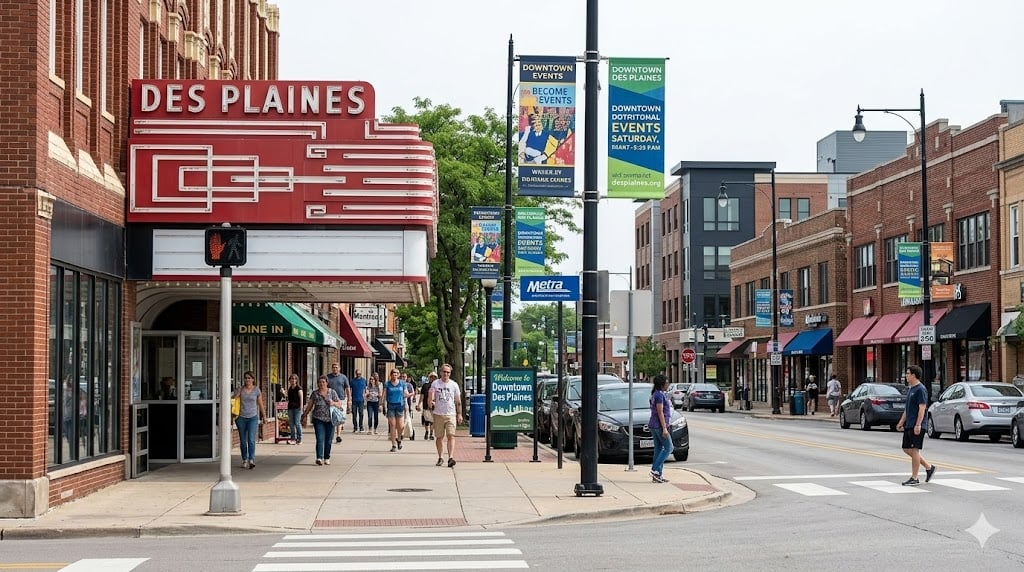
Updated: September 20, 2026
Yes, some people can live in downtown Des Plaines without a car, especially if they live near the Metra station and regularly travel to downtown Chicago. For many households, though, car-light living or keeping one shared car is more practical because grocery shopping, medical visits, and trips across the suburbs may still require driving.
Key Takeaways
Downtown Des Plaines offers one of the more practical car-light locations in Chicago’s Northwest Suburbs.
The Des Plaines Metra station is on the Union Pacific Northwest Line and sits in the downtown district.
Pace adds useful connections, including the Pulse Dempster Line and weekday Route 230 service to the Rosemont CTA Blue Line station.
The library, City Hall, restaurants, coffee shops, and personal services are clustered near the station.
Grocery shopping, medical visits, late-night travel, and trips across multiple suburbs are the most likely pressure points.
For many households, living with one shared car will be easier than living with no car at all.
Can you live without a car in downtown Des Plaines?
You can, if your home and weekly routine line up with the transit network. Living close to the station matters, but your destination matters just as much.
The strongest version of this lifestyle is someone who walks to Metra for a Chicago commute, handles several errands downtown, and uses Pace, delivery, rideshare, or an occasional rental car for the remaining trips. It becomes harder when work, medical care, family visits, or regular activities are spread across the suburbs.
My honest answer is that downtown Des Plaines can work without a car for the right person. It is an easier and more flexible fit for car-light living or a one-car household.
The best way to decide is to map an ordinary week rather than an ideal day.
Which Metra line serves downtown Des Plaines?
The Des Plaines station is on Metra’s Union Pacific Northwest Line, which ends at Ogilvie Transportation Center in Chicago. Metra lists the station at 1501 Miner Street in the downtown district.
That location is the biggest reason car-free living is possible here. A resident of a nearby apartment, condominium, or house may be able to walk to the platform instead of driving to the station and paying for parking.
Trip times and frequency vary by train and day. Before choosing a home around a commute, check the current Des Plaines station information and schedule for the exact train you would use. Pay attention to the return trip too, especially if you work late or expect to use the train on weekends.
If you are comparing Northwest Suburban train options, this guide to using Metra for a Chicago commute explains why the exact train and terminal matter more than a general commute estimate.
Where can you go from downtown Des Plaines by Pace bus?
Pace expands the number of trips you can make without a car, but its usefulness depends on your destination, the day, and the hour.
The Pulse Dempster Line runs between Evanston and O’Hare International Airport’s Multi-Modal Facility, with a stop near the Des Plaines Metra station. Pace currently lists service every 15 minutes through most daytime and evening hours, with 20-minute service during later and early hours. Confirm the current schedule before relying on it.
Pace Route 230 provides weekday service between Des Plaines and the Rosemont CTA Blue Line station. Pace also lists Route 234 between Des Plaines and Wheeling, with rush-hour service extending between the Des Plaines Metra station and the Pace Buffalo Grove Terminal.
These connections are useful, but they are not interchangeable. Route 230 and Route 234 have weekday limits, while Pulse has a different service pattern. A route that appears on a map is only useful if it runs when you need it.
For a closer look at another transit option in the area, read about CTA Blue Line access from southern Des Plaines.
What can you walk to in downtown Des Plaines?
From homes close to the station, residents may be able to walk to the Des Plaines Public Library, City Hall, restaurants, coffee shops, personal services, Metra, and Pace stops.
The Des Plaines Public Library is especially useful because it offers work and study space, computers and Wi-Fi, meeting rooms, programs, printing, scanning, and other services in the downtown area.
The distance shown on a map does not tell the whole story. A short route can still involve a busy intersection, a long signal, limited shelter, or sidewalks that feel very different with snow and ice.
Grocery shopping deserves the closest inspection. Look at the route to the store you would actually use, not simply the nearest grocery marker on a map. Think about how you would carry a larger order home and what you would do in bad weather.
Which trips are hardest without a car?
The hardest trips are usually the ones that do not follow the Metra line or a frequent Pace route. In practice, these may include:
Medical or therapy appointments in another suburb
Workplaces outside downtown Chicago
Evening activities after bus frequency drops
Larger grocery and household purchases
Visits to people who do not live near transit
Veterinary appointments or trips with a pet
Weekend plans that require several stops
None of these automatically rules out car-free living. They do affect cost and convenience. Add up the delivery fees, rideshare trips, rental cars, and extra travel time you would realistically use in a month.
That total gives you a better comparison than looking only at the cost of owning a car.
What does car-light living look like in downtown Des Plaines?
Car-light living means using walking and transit for routine trips while keeping another option for the journeys that do not fit.
A workable routine might include walking to Metra, taking Pulse for an airport or Dempster Street trip, using Route 230 for the Rosemont Blue Line on a weekday, ordering a larger grocery delivery, and booking a rideshare for an occasional appointment.
For a household with two adults, reducing from two cars to one may provide the best balance. One person can walk to Metra while the shared car remains available for appointments, errands, and suburban travel.
This approach preserves much of the financial and practical benefit of driving less without forcing every trip into the transit network.
What types of homes are near the Des Plaines Metra station?
Housing near downtown includes apartments, condominiums, and detached homes in the surrounding residential streets. The most walkable option is not always the best overall choice, so compare the building and the route together.
For a condominium, review:
Monthly association fees and what they cover
Parking spaces and guest-parking rules
Building reserves and recent financial statements
Meeting minutes and planned projects
Pending or recent special assessments
Pet and rental restrictions
Elevator access and building maintenance
Storage, package delivery, and bike storage
Parking still matters even if you plan to drive less. A unit with no deeded or assigned space can be difficult if your needs change later. A unit with two spaces may carry value even when you expect to keep only one vehicle.
Is downtown Des Plaines a good fit if you are moving from Chicago?
It can be a practical transition for someone who wants suburban housing while keeping Metra access and some walkable daily destinations. The downtown district offers a more compact routine than many parts of the Northwest Suburbs.
The adjustment is still real. Metra follows a schedule, and it ends at Ogilvie rather than running through the city like a CTA train. Suburban bus routes may be less frequent than the buses you are used to in Chicago. Some errands will take more planning.
If you are making a broader move, this guide to relocating to Chicago’s Northwest Suburbs can help you compare the full routine, not only the train ride.
How should you test car-free living before choosing a home?
Test the exact address on one ordinary weekday and one weekend day. Do not rely only on a walk score, a map pin, or a Saturday afternoon visit.
Start at the home and try the trips that would shape your week:
Walk to the Metra platform at your normal departure time.
Check the specific train you would take and the trip from Ogilvie to your final destination.
Walk to the grocery store you would actually use.
Find the nearest useful Pace stop and check return service.
Test a medical, social, or family trip that does not go downtown.
Repeat one route after dark or in less comfortable weather.
Notice curb cuts, signal timing, lighting, sidewalk conditions, construction, and how long you spend waiting outside. Accessibility is route-specific. A building may have an elevator while the trip around it still presents barriers.
Then price the gaps. Estimate what you would spend on deliveries, rideshare, car rental, or keeping one shared car. The right choice is the routine that still works on a tired Tuesday, not only on a pleasant weekend.
Is living car-free in downtown Des Plaines realistic?
Yes, but only for a fairly specific routine. It works best when you live close to the station, commute along the Union Pacific Northwest Line, and can handle many regular needs downtown or through Pace.
For most households, I would evaluate downtown Des Plaines as a strong car-light option rather than assume it is fully car-free. Keeping one car may remove the hardest transportation gaps while still allowing you to walk or use transit for much of the week.
The address matters more than the town name. Two homes listed as “downtown Des Plaines” can create very different daily experiences depending on the walking route, intersections, bus stops, and distance to the platform.
Want to compare homes near downtown Des Plaines?
If you are trying to decide whether a specific building supports a car-free or one-car routine, I can help you compare the home, association, parking, transit, and weekly travel pattern together.
Book a conversation with Mari or visit MyRealtorMari.com to start with the questions that matter most to your move.
About the Author
Mari Van Meter is a REALTOR® with the Dragonfly Home Team at Berkshire Hathaway HomeServices American Heritage Real Estate. She holds the C2EX, SRES, PSA, and ABR designations and serves the Northwest Suburbs of Chicago. Mari helps homeowners navigate divorce, downsizing, relocation, and other major life changes with clarity and care, bringing calm structure and emotional awareness to difficult decisions. Learn more at MyRealtorMari.com.
Common Questions About Car-Free Living in Downtown Des Plaines
Is downtown Des Plaines walkable?
The area around the Des Plaines Metra station is compact enough for some residents to walk to the library, City Hall, restaurants, coffee shops, services, Metra, and Pace stops. Walkability changes by address, so test the exact route and intersections you would use.
Which Metra line serves Des Plaines?
The downtown Des Plaines station is on Metra’s Union Pacific Northwest Line, which travels to Ogilvie Transportation Center in Chicago. Metra lists the station at 1501 Miner Street. Check the current timetable for the train that matches your work hours.
Can I get from downtown Des Plaines to O’Hare without a car?
Yes. Pace’s Pulse Dempster Line connects the Des Plaines station area with O’Hare’s Multi-Modal Facility. From there, airport travelers can use O’Hare’s internal transportation. Confirm the current Pulse schedule and allow time for the transfer.
Can I reach the CTA Blue Line from Des Plaines by bus?
Yes. Pace Route 230 provides weekday service between Des Plaines and the Rosemont CTA Blue Line station. Service days and times matter, so check the current Pace schedule for both the outbound and return trips before relying on it.
Can a household live in downtown Des Plaines with one car?
For many households, one car is more realistic than no car. If one or more residents can walk to Metra and use Pace for selected trips, the shared car can cover medical visits, larger errands, evening travel, and destinations spread across the suburbs.
What should I check before buying a condo near the Des Plaines Metra station?
Review the association budget, reserves, financial statements, meeting minutes, planned projects, special assessments, parking, pet rules, rental restrictions, elevator access, and building maintenance. Also walk the route from the unit to the station and the grocery store you expect to use.